
Ransomware Threats in Europe H1 2026: A Deep Dive into Regional Attack Patterns and Dominant Threat Actors
Europe faced a ransomware onslaught in the first half of 2026 that sets a troubling precedent for the remainder of the year. According to Cyble Research and Intelligence Labs (CRIL), the region experienced 866 documented ransomware attacks, 51 confirmed data breach incidents, and 7 initial access sales between January and June 2026. These figures represent not just a volume problem, but a fundamental shift in how threat actors are organizing, targeting, and monetizing their operations within European territory.
What distinguishes the ransomware threats in Europe from other global regions is the concentration of power among a small number of highly sophisticated threat actors. While the threat ecosystem encompasses dozens of groups, five dominant ransomware operators account for approximately 55% of all documented activity. This concentration creates predictability—European security leaders can now identify, profile, and build specific defensive strategies against known adversaries.
The Five Dominant Ransomware Groups Targeting Europe
1. Qilin: The Biggest Ransomware Threat in Europe
Attack Volume: 158 documented incidents (18.2% of regional total)
Qilin stands as the dominant ransomware threat actor targeting Europe, commanding operational superiority through sophisticated affiliate management, rapid exploit weaponization, and industry-specific targeting intelligence.
Geographic Concentration:
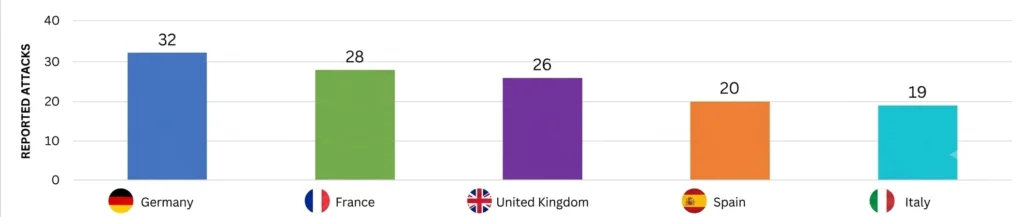
- Germany: 32 attacks (highest single-country targeting)
- France: 28 attacks
- United Kingdom: 26 attacks
- Spain: 20 attacks
- Italy: 19 attacks
Worldwide Sectoral Targeting: Qilin demonstrates deliberate sectoral selection rather than opportunistic targeting:
- Construction: 103 incidents (primary focus)
- Professional Services: 90 incidents (legal, accounting, consulting firms)
- Manufacturing: 67 incidents (industrial operations)
- Government & Law Enforcement: 19 incidents
- Technology: 22 incidents
Operational Characteristics:
Qilin’s dominance stems from understanding European organizational economics. Construction projects operate under time-sensitive contracts with contractually-defined penalties for delay. A single day of downtime on a €50 million construction project can trigger cascading costs exceeding €100,000. This economic reality translates directly into ransom payment likelihood, making Qilin’s targeting strategy rational and highly effective.
The group maintains an extensive affiliate network capable of concurrent operations across multiple European nations. Evidence suggests Qilin has compartmentalized its operations: initial access brokers handle reconnaissance and network compromise, mid-tier operators manage lateral movement and privilege escalation, and final-stage operators execute encryption and exfiltration. This division of labor enables rapid scaling and reduces attribution risk.
Why Qilin Dominates:
- Industry Expertise: Deep understanding of construction project timelines and financial exposure
- Affiliate Loyalty: Competitive payout structures (estimated 70-80% to affiliates) ensure consistent operator recruitment
- Exploit Library: Rapid weaponization of both known and zero-day vulnerabilities
- Data Monetization: Established data brokerage partnerships ensure exfiltrated data reaches buyers
European Security Implications: Organizations in construction, professional services, and manufacturing should treat Qilin as their primary threat actor concern. Defensive strategies must prioritize data exfiltration prevention, network segmentation, and immutable backup infrastructure.
2. The Gentlemen: The Rising European Threat
Attack Volume: 144 documented incidents (16.6% of regional total)
The Gentlemen represent an emerging threat actor that has achieved remarkable scale in a relatively short operational window. Unlike established groups that evolved from other cybercriminal operations, The Gentlemen appear purpose-built for ransomware-as-a-service operations.
Geographic Concentration:
- Europe: 144 attacks (primary focus)
- United States: 100 attacks (secondary focus)
- Thailand: 35 attacks (supply-chain targeting)
- South Asia: 40 attacks
Worldwide Sectoral Targeting:
- Construction: 45 incidents
- Manufacturing: 56 incidents
- Healthcare: 37 incidents
- IT & ITES: 36 incidents
- Professional Services: 29 incidents
Operational Characteristics:
The Gentlemen’s rapid emergence and sustained growth suggest significant operational funding and technical sophistication. The group’s geographic diversification—maintaining European dominance while aggressively expanding into Asia-Pacific—indicates either organizational scale or partnerships with regional threat actors.
Notably, The Gentlemen’s Thailand targeting (35 incidents) suggests supply-chain attack sophistication. By compromising manufacturing and logistics operations in Thailand, the group can leverage these beachheads for downstream attacks against Western European organizations. This cross-continental supply-chain targeting represents a significant evolution in ransomware operational sophistication.
Key Distinction: While Qilin focuses on maximizing ransom payments from individual targets, The Gentlemen appear to prioritize operational scale and geographic expansion. This suggests the group may be building toward either:
- A mega-RaaS platform rivaling LockBit’s historical dominance
- Preparation for potential acquisition or partnership with state-sponsored actors
- Geographic arbitrage—leveraging lower prosecution risk in developing nations while maintaining European operations
European Security Implications: The Gentlemen’s emergence signals market competition is intensifying. Organizations should monitor this group’s operational evolution closely, as aggressive growth often precedes operational mistakes that create defensive opportunities.
3. LockBit: The Persistent Legacy Threat
Attack Volume: 61 documented incidents (7.0% of regional total)
LockBit’s presence in European targeting represents a significant finding given sustained law enforcement pressure and multiple platform disruption attempts. Despite being targeted by coordinated international takedown operations, LockBit maintained operational capability throughout H1 2026.
Geographic Concentration:
- Europe: 61 attacks (Primary operations)
- North America: 47 attacks (Secondary operations)
- Distributed: Global presence indicating resilient infrastructure
Worldwide Sectoral Targeting:
- Construction: 22 incidents
- Manufacturing: 22 incidents
- Government & LEA: 12 incidents
- Healthcare: 19 incidents
- Professional Services: 13 incidents
Operational Resilience:
LockBit’s continued operations despite international enforcement actions demonstrate several critical lessons:
- Affiliate Compartmentalization: By maintaining separate operational cells, LockBit can continue operations even when core infrastructure is disrupted
- Rapid Rebranding: The group has adopted multiple identities and platform variants, complicating attribution
- Infrastructure Redundancy: Multiple command-and-control server locations across jurisdictions with varying law enforcement cooperation levels
- Operator Recruitment: Continuous recruitment of new affiliates from emerging cybercriminal talent pools
The group’s continued viability suggests that law enforcement actions, while disruptive, are insufficient to eliminate established RaaS operations. Organizations cannot rely on law enforcement intervention as a defensive strategy; they must assume LockBit and similar groups will remain operational threats indefinitely.
European Security Implications: LockBit should remain on European security teams’ active threat monitoring lists. The group maintains technical sophistication, access to critical zero-day exploits, and demonstrated willingness to target European critical infrastructure.
4. Akira: The Opportunistic European Operator
Attack Volume: 59 documented incidents (6.8% of regional total)
Akira represents a secondary-tier ransomware group with focused European operations. The group demonstrates strong preference for Manufacturing and Construction sectors, suggesting industry-specific expertise or targeted affiliate recruitment.
Geographic Concentration:
- Europe & UK: 59 attacks (Secondary focus)
- North America: 268 attacks (Primary focus)
- Secondary: Limited operations in other regions
Worldwide Sectoral Targeting:
- Manufacturing: 54 incidents
- Construction: 57 incidents
- Professional Services: 47 incidents
- Consumer Goods: 34 incidents
- Healthcare: 13 incidents
Operational Profile:
Akira’s disproportionate North American presence (268 attacks) with lower European activity (59 attacks) suggests the group may have established affiliate networks in North America with secondary capacity for European operations. The strong manufacturing and construction focus mirrors Qilin’s strategy, indicating these sectors offer superior ransom payment likelihood across multiple geographic markets.
European Security Implications: While not as immediately threatening as Qilin or The Gentlemen, Akira’s persistent operations warrant inclusion in threat modeling exercises. European manufacturing and construction organizations should monitor Akira’s affiliate recruitment channels and tactical innovations.
5. Dragonforce: The Supply-Chain Specialist
Attack Volume: 54 documented incidents (6.2% of regional total)
Dragonforce rounds out the top-five European threat actors with apparent specialization in Manufacturing and Technology sectors, suggesting possible supply-chain attack capabilities.
Geographic Concentration:
- North America: 135 attacks (Primary focus)
- Europe & UK: 54 attacks (Secondary focus)
- Secondary: Limited global operations
Worldwide Sectoral Targeting:
- Manufacturing: 31 incidents
- Construction: 48 incidents
- Professional Services: 28 incidents
- Food & Beverages: 9 incidents
- Healthcare: 9 incidents
Operational Pattern:
Dragonforce’s heavy US focus with secondary European operations suggests the group may be leveraging North American-based supply chains to gain access to European targets. Manufacturing supply chains are deeply interconnected across transatlantic partners; compromising US manufacturers could provide lateral access into European operations.
European Security Implications: European manufacturing organizations should implement aggressive third-party risk management programs, particularly for US-based suppliers. Dragonforce’s supply-chain sophistication suggests the group may bypass direct targeting in favor of compromising upstream vendors.
Also read: The Most Active Threat Actors of H1 2026
The Five Most Targeted European Nations
Germany: The Manufacturing Battleground
Attack Volume: 155 ransomware attacks (17.9% of regional total)
Germany’s position as Europe’s manufacturing powerhouse places it at the center of ransomware targeting campaigns. The nation’s industrial sector—encompassing automotive, machinery, chemicals, and precision manufacturing—represents the most valuable ransomware target set in Europe.
Threat Actor Concentration:
- Qilin: 32 attacks (20.6% of German total)
- The Gentlemen: 32 attacks
- LockBit: 18 attacks
- Akira: 32 attacks
- Dragonforce: 9 attacks
Sectoral Breakdown:
- Manufacturing: 67 incidents (significant concentration)
- Construction: 38 incidents
- Professional Services: 28 incidents
- Technology: 15 incidents
- Healthcare: 12 incidents
Why Germany Faces Maximum Pressure
German organizations represent an optimal target combination: high asset value, supply-chain criticality, strong operational technology integration, and proven willingness to pay ransoms to maintain production schedules. Additionally, Germany’s federal structure creates jurisdictional complexity that may slow law enforcement response.
The nation’s Mittelstand (mid-market manufacturing firms) are particularly vulnerable—large enough to justify ransom payments, but sometimes lacking enterprise-grade security infrastructure.
Defensive Priority: German manufacturing organizations should assume Qilin, The Gentlemen, Akira, and Dragonforce all maintain active operations targeting their sector. Network segmentation between IT and operational technology (OT) environments should be elevated to critical priority.
United Kingdom: The Financial Services Crosshairs
Attack Volume: 138 ransomware attacks (15.9% of regional total)
The UK faces a different threat profile than Germany, driven primarily by London’s position as a global financial services hub. While manufacturing is targeted, Banking, Financial Services, and Insurance (BFSI) organizations command disproportionate attention.
Threat Actor Concentration:
- Qilin: 26 attacks
- The Gentlemen: 26 attacks
- LockBit: 18 attacks
- Akira: 13 attacks
- Dragonforce: 11 attacks
Sectoral Breakdown:
- BFSI: 38 incidents (concentrated targeting)
- Technology: 32 incidents
- Retail: 26 incidents
- Professional Services: 24 incidents
- Government & LEA: 16 incidents
Why the UK Is Targeted
London’s financial services ecosystem manages trillions in assets, making it extraordinarily valuable to data-exfiltrating threat actors. BFSI organizations hold customer financial data, internal financial records, and strategic information that commands premium prices on dark web marketplaces.
Additionally, regulatory requirements (FCA, PRA, etc.) create pressure for rapid ransom payment to avoid breach notification delays that could trigger regulatory sanctions.
Data Exfiltration Risk: The UK’s status as a financial services hub makes it particularly vulnerable to data-centric attack strategies. Organizations should assume that successful breach attempts will include aggressive data exfiltration alongside encryption deployment.
Defensive Priority: UK BFSI organizations must implement robust data loss prevention (DLP), encryption for data in transit and at rest, and aggressive monitoring for unauthorized data access or exfiltration attempts.
France: The Balanced Threat
Attack Volume: 119 ransomware attacks (13.7% of regional total)
France experiences balanced threat distribution across multiple sectors, reflecting both its manufacturing capacity and significant professional services sector.
Threat Actor Concentration:
- Qilin: 28 attacks
- The Gentlemen: 28 attacks
- LockBit: 15 attacks
- Akira: 14 attacks
- Dragonforce: 8 attacks
Sectoral Breakdown:
- Professional Services: 26 incidents
- Manufacturing: 24 incidents
- Construction: 19 incidents
- Technology: 14 incidents
- Healthcare: 10 incidents
Why France Faces Distributed Threat
As Europe’s second-largest economy, France is attractive to ransomware operators across multiple sectors. The nation’s professional services sector (legal, accounting, consulting) is particularly valuable for data exfiltration, while manufacturing remains a consistent target.
Defensive Priority: French organizations should implement sector-specific defensive strategies: professional services firms should prioritize client data protection and DLP, while manufacturing organizations should focus on OT segmentation and operational resilience.
Italy: The Construction and Manufacturing Hub
Attack Volume: 115 ransomware attacks (13.3% of regional total)
Italy faces concentrated targeting in construction and manufacturing sectors, with particular pressure on small-to-medium enterprises in industrial regions.
Threat Actor Concentration:
- Qilin: 19 attacks
- The Gentlemen: 18 attacks
- LockBit: 12 attacks
- Akira: 16 attacks
- Dragonforce: 8 attacks
Sectoral Breakdown:
- Construction: 48 incidents (concentrated)
- Manufacturing: 38 incidents
- Professional Services: 18 incidents
- Retail: 14 incidents
Why Italy Faces Sector-Specific Pressure
Italy’s construction industry is particularly vulnerable to ransom attacks due to tight project timelines and significant financial exposure. The nation’s manufacturing sector, while sophisticated, sometimes operates with legacy infrastructure that creates exploitation opportunities.
Defensive Priority: Italian construction and manufacturing organizations should prioritize incident response readiness, backup infrastructure resilience, and supply-chain risk management.
Spain: The Emerging Risk
Attack Volume: 87 ransomware attacks (10.0% of regional total)
Spain experiences lower absolute attack volume than Germany, UK, France, or Italy, but faces concentrated pressure in manufacturing and professional services sectors.
Threat Actor Concentration:
- Qilin: 20 attacks
- The Gentlemen: 18 attacks
- LockBit: 8 attacks
- Akira: 12 attacks
- Dragonforce: 7 attacks
Sectoral Breakdown:
- Manufacturing: 28 incidents
- Professional Services: 19 incidents
- Construction: 16 incidents
- Technology: 10 incidents
Regional Observation: Spain’s lower attack volume may reflect either lower overall ransomware targeting or more effective defensive implementations. Spanish security teams should not interpret lower numbers as reduced threat but rather as a baseline for future comparison.
Where European Organizations Face Maximum Risk: A Sectoral Analysis
Construction: The Ransomware Goldmine
Attack Volume: 107 documented incidents (58% of all sector targeting across regions – not just in Europe – analyzed)
Construction organizations face disproportionate ransomware targeting across the entire European region. This concentration reflects understood economic vulnerabilities that threat actors exploit with precision.
Why Construction Is Targeted
- Time-Sensitive Financial Exposure: Construction projects operate under contractually-defined timelines. Each day of delay triggers cascading costs, financial penalties, and potential contract termination. Organizations facing potential loss of €50-100 million contracts will prioritize rapid recovery over law enforcement involvement.
- Operational Technology Integration: Modern construction increasingly relies on Building Information Modeling (BIM), cloud-based project management, and real-time equipment tracking. This IT/OT convergence creates exploitation pathways unavailable in purely IT-based industries.
- Supply-Chain Complexity: Construction projects depend on dozens of subcontractors and suppliers. Compromising a single upstream supplier can provide lateral access into prime contractors.
- Financial Pressure: Construction firms often operate with tight cash flow, making ransom negotiation essential to preserve solvency.
- Accessibility: Many construction firms, particularly smaller regional players, operate with basic security infrastructure, creating easy exploitation opportunities.
European Construction Risk Mapping:
- Germany (14 attacks): Heavy machinery and precision manufacturing integration
- Switzerland (10 attacks): Legacy infrastructure vulnerabilities
- Spain (13 attacks): Emerging targeting activity
- France (10 attacks): Balanced threat across major metropolitan areas
- UK (21 attacks): Infrastructure project concentration (rail, utilities, etc.)
Defensive Recommendations for Construction:
- Network Segmentation: Isolate operational technology (project equipment, heavy machinery) from corporate IT networks
- Access Control: Implement strict authentication for remote project management tools (Autodesk Forge, Procore, etc.)
- Immutable Backups: Maintain offline, immutable backups of critical BIM files and project documentation
- Incident Response Readiness: Develop construction-specific response playbooks addressing project continuity
- Supply-Chain Due Diligence: Implement security requirements for subcontractors and equipment suppliers
Professional Services: The Data Exfiltration Target
Attack Volume: 86 documented incidents
Professional services firms (law, accounting, consulting) face sophisticated targeting driven by data exfiltration opportunities rather than operational disruption pressure.
Why Professional Services Are Targeted
- Client Confidentiality Risk: Legal privilege and client confidentiality create existential regulatory and reputational exposure. Threat actors leverage this to demand premium ransoms.
- Sensitive Data Concentration: Professional services firms accumulate client financial records, litigation strategies, tax information, and corporate secrets—all commanding premium dark web prices.
- Regulatory Exposure: GDPR breach notification requirements create pressure for rapid response and ransom payment to avoid regulatory sanctions.
- Supply-Chain Position: Professional services firms advise major corporations; compromising advisors provides indirect access to clients.
- Trust-Based Business Model: Client relationships depend on confidentiality. A single breach can destroy long-term client relationships and firm reputation.
European Professional Services Risk:
- France (16 attacks): Concentrated targeting of Paris-based firms
- Germany (16 attacks): Heavy focus on Frankfurt financial advisory firms
- UK (17 attacks): London-based legal and accounting partnerships
- Italy (6 attacks): Milan and Rome-based advisory firms
- Spain (7 attacks): Barcelona and Madrid professional services sector
Key Finding: Professional services firms experience disproportionate data breach incidents (exfiltration with confirmed leak activity) compared to other sectors. Of the 51 total data breach incidents across Europe and UK, professional services represents a concentrated target.
Defensive Recommendations:
- Client Data Segregation: Isolate client data on separate network segments with distinct access controls
- Data Loss Prevention (DLP): Deploy DLP solutions with aggressive egress controls monitoring client data exfiltration
- Encryption Standards: Implement client-facing encryption for all sensitive communications
- Access Auditing: Maintain comprehensive logs of all access to sensitive client data
- Ransomware-Specific Insurance: Consider cyber insurance with specific ransomware coverage addressing confidentiality exposure
Manufacturing: The Supply-Chain Critical Target
Attack Volume: 123 documented incidents
European manufacturing organizations face sophisticated, supply-chain-aware threat actors who understand production dependencies and downtime economics.
Why Manufacturing Is Targeted
- Operational Technology Integration: Modern factories integrate IT and OT systems. Ransomware deployment can halt production lines, creating catastrophic financial exposure.
- Supply-Chain Criticality: Manufacturing downtime cascades through dependent enterprises. A single organization’s compromise can impact dozens of downstream customers.
- Export Dependency: European manufacturers serve global markets. Production delays translate directly into lost revenue and market share.
- Legacy Infrastructure: Many manufacturing facilities operate aging, unpatched systems integrated with newer IT infrastructure, creating exploitation bridges.
- Financial Pressure: Manufacturing organizations face razor-thin margins; production downtime can drive solvency crises.
Geographic Manufacturing Risk Concentration:
- Germany (27 attacks): Automotive, machinery, precision manufacturing
- Italy (21 attacks): Fashion, machinery, chemical manufacturing
- France (15 attacks): Automotive, aerospace, industrial manufacturing
- Spain (10 attacks): Automotive, machinery, manufacturing
- UK (14attacks): Aerospace, automotive, precision manufacturing
Critical Vulnerability Pattern: Manufacturing organizations are disproportionately targeting known, exploitable vulnerabilities in critical infrastructure appliances (network appliances, security tools, identity systems). Rather than deploying zero-days, threat actors exploit patched vulnerabilities that organizations have not implemented.
Defensive Recommendations:
- OT/IT Segmentation: Implement airgapped network separation between operational technology and corporate IT
- Vulnerability Management Prioritization: Focus patching efforts on network appliances, security tools, and identity systems
- Industrial Control System (ICS) Monitoring: Deploy behavioral monitoring for unusual activity on manufacturing control systems
- Immutable Backup Strategy: Maintain completely offline backups of critical manufacturing configurations
- Supply-Chain Security Program: Implement tier-1 and tier-2 supplier security assessments and vulnerability scanning
- Incident Response Scenario Planning: Develop detailed playbooks for production-line ransomware scenarios
Healthcare: The Critical Infrastructure Threat
Attack Volume: 35 documented incidents
Healthcare organizations face a unique threat dynamic where ransomware directly endangers patient safety, creating existential operational pressure distinct from financial threats.
Why Healthcare Is Targeted
- Patient Safety Risk: Ransomware disables critical medical systems (diagnostic equipment, pharmaceutical dispensing, patient records). Unlike other industries, downtime directly threatens life.
- Regulatory Pressure: GDPR, HIPAA-equivalent regulations, and national privacy laws create breach notification requirements that incentivize ransom payment.
- Data Value: Patient medical records, pharmaceutical research data, and clinical trial information command premium dark web prices.
- Continuous Operation Requirement: Unlike manufacturing or services, healthcare cannot delay critical procedures. The operational pressure to pay ransoms is existential.
- System Complexity: Healthcare IT environments integrate numerous legacy systems (PACS, EHR, medical devices) with varying security architectures.
European Healthcare Risk Distribution:
- Germany (14 attacks): Concentrated in Berlin, Munich, and Frankfurt urban medical centers
- Austria (2 attacks): private healthcare sector
- France (5 attacks): Concentrated in Paris and Lyon region hospitals
- Switzerland (3 attacks): medical centers
- Spain (3 attacks): Barcelona and Madrid hospital networks
Critical Finding: Healthcare organizations experience disproportionately high data breach incident rates, suggesting organized threat actors specifically target health information exfiltration.
Defensive Recommendations:
- Clinical System Isolation: Implement complete network separation between clinical systems and corporate IT
- Redundant Critical Systems: Deploy redundant diagnostic and pharmaceutical systems capable of manual operation
- Patient Data Encryption: Implement end-to-end encryption for all patient medical records
- Breach Response Planning: Develop healthcare-specific incident response plans addressing patient notification and continuity of care
- Medical Device Security: Implement inventory and monitoring for all connected medical devices
- Supply-Chain Assessment: Assess security of medical device manufacturers and pharmaceutical distributors
The Data Exfiltration Reality: Beyond Encryption
Confirmed Data Breaches: 51 Incidents Across Europe and UK
While ransomware attacks total 866, only 51 incidents resulted in confirmed data breaches and leaks (5.9% confirmation rate). This apparent low percentage masks a critical operational truth: organizations cannot distinguish between encryption-only attacks and data exfiltration scenarios until exfiltration attempts or threats emerge.
Data Breach Distribution by Sector:
| Sector | Confirmed Breaches | Percentage |
| BFSI | 9 | 17.6% |
| Telecom | 9 | 17.6% |
| Retail | 8 | 15.7% |
| Government & LEA | 6 | 11.8% |
| Media & Entertainment | 5 | 9.8% |
| Technology | 4 | 7.8% |
| Healthcare | 4 | 7.8% |
| Automotive | 3 | 5.9% |
| Construction | 2 | 3.9% |
| Education | 1 | 2.0% |
| Others | 6 | 11.8% |
Critical Observation: BFSI and Telecom sectors experience disproportionate data breach incidents, suggesting these industries are specifically targeted for data exfiltration rather than operational disruption. The strategic implication is clear: threat actors targeting financial and telecommunications organizations prioritize data monetization over ransom payment.
Most Active Threat Actors in Data Exfiltration: The Leak Economy
Primary Exfiltration Actors:
| Actor | Confirmed Leak Posts | Targeting Pattern |
| tanaka | 6 | Industry-agnostic, global operations |
| kazutlg | 4 | BFSI and Professional Services focus |
| aslan1 | 2 | Government and Technology sectors |
| darkcybervault | 2 | Retail and Professional Services |
| breach3d | 2 | Technology focus |
| frog | 2 | Diverse sector targeting |
| ken6k | 2 | BFSI concentration |
| max9898 | 2 | Retail and Technology |
| worldrdp | 2 | Technology sector |
| zyad2drkwb | 2 | Government targeting |
| zoozkooz | 2 | Diverse sector |
| mr_x1 | 1 | Retail focus |
| ventuuas | 1 | Professional Services |
| Others | 18 | Distributed diverse targeting |
Strategic Finding: While Qilin, The Gentlemen, and LockBit dominate ransomware attack volume, data exfiltration is fragmented across numerous smaller actors, including tanaka (6 posts), kazutlg (4 posts), and dozens of single-incident operators. This suggests a mature data brokerage ecosystem where extracted data is resold to specialized exfiltration actors.
Dark Web Data Marketplace Activity:
- 916 unique domains impacted by data leaks
- Approximately 86 distinct leak posts across dark web channels
- Data types: Financial records, customer PII, medical records, intellectual property, trade secrets
Implication: Organizations can no longer assume encrypted data is “lost forever” if backups are restored. Exfiltrated data will be monetized regardless of whether organizations pay ransoms. Data loss prevention becomes as critical as ransomware detection.
Geopolitical and Ideological Dimensions: The Activism-Cybercrime Convergence
Pro-Russian Hacktivism: Blurred Lines Between Ideology and Profit
H1 2026 witnessed increasing overlap between geopolitically motivated hacktivism and financially motivated cybercrime, particularly among pro-Russian collectives targeting NATO-aligned European nations.
Key Threat Actors to Monitor
NoName057(16) – The Pro-Russian DDoS Coalition
- Primary Activity: Large-scale DDoS attacks against NATO-aligned governments and Ukrainian supporters
- Secondary Activity: Data exfiltration for monetization
- Geographic Targets: Estonia, UK, Ukraine, Italy, Spain, France, Poland, Norway, Denmark, Lithuania, Latvia, Czech Republic, Germany, Moldova
- Operational Pattern: Coordinated DDoS campaigns often accompanied by data theft and subsequent leak activity
Operational Evolution: NoName057(16) began as a purely activist collective claiming ideological motivation (anti-NATO, pro-Russia). By H1 2026, the group had evolved to include data exfiltration and monetization—suggesting either organizational evolution or infiltration by financially motivated threat actors.
Strategic Implication: European organizations cannot compartmentalize threat modeling. A geopolitically motivated attack that begins as a DDoS campaign can transition into ransomware deployment when exfiltration opportunities present themselves.
Strategic Defense Recommendations for European Organizations
Prioritized Defensive Roadmap
Based on CRIL’s H1 2026 regional data, European security leaders should prioritize defensive investments in the following sequence:
Phase 1: Critical Infrastructure Protection (30 days)
- Inventory Network Appliances: Document all network appliances (firewalls, SD-WAN platforms, security gateways, VPNs)
- Patch Critical CVEs: Prioritize patches for Cisco, Ivanti, Palo Alto, Fortinet, and Microsoft appliances
- Access Control Hardening: Implement MFA for all remote administrative access to network infrastructure
- Monitoring Deployment: Deploy behavioral monitoring on network appliances for anomalous activity
Phase 2: Data Protection (60 days)
- Data Inventory: Identify and catalog sensitive data holdings (customer data, financial records, intellectual property)
- DLP Implementation: Deploy data loss prevention solutions with egress monitoring
- Encryption Standards: Implement encryption for data in transit (TLS 1.3+) and at rest (AES-256)
- Access Logging: Enable comprehensive audit logging for all sensitive data access
Phase 3: Operational Resilience (90 days)
- Immutable Backups: Establish offline, immutable backup infrastructure isolated from network access
- Incident Response Planning: Develop organization-specific incident response playbooks addressing ransomware scenarios
- Business Continuity: Identify critical business functions and develop continuity strategies
- Disaster Recovery Testing: Conduct quarterly backup restoration testing to verify recovery capabilities
Phase 4: Threat Hunting and Detection (Ongoing)
- Threat Intelligence Integration: Subscribe to European threat intelligence feeds focusing on Qilin, The Gentlemen, LockBit, Akira, and Dragonforce
- Behavioral Detection: Deploy endpoint detection and response (EDR) solutions with behavioral analytics
- Supply-Chain Monitoring: Implement continuous monitoring of vendor and supplier security posture
- Insider Threat Program: Develop insider threat detection capabilities focusing on data exfiltration attempts
Regional Threat Actor Summary: Who Targets Your European Organization
Sector-Specific Threat Actor Mapping
If You’re in Construction:
- Primary Threat: Qilin, The Gentlemen
- Secondary Threat: Akira, Dragonforce
- Vulnerability: Network segmentation gaps, supply-chain vulnerabilities, legacy OT systems
- Defensive Focus: OT/IT segmentation, immutable backups, supplier security assessment
If You’re in Professional Services:
- Primary Threat: Qilin, The Gentlemen
- Secondary Threat: LockBit, Akira
- Vulnerability: Client data exfiltration, regulatory exposure, ransomware payment pressure
- Defensive Focus: DLP, client data encryption, ransomware-specific insurance
If You’re in Manufacturing:
- Primary Threat: Qilin, The Gentlemen
- Secondary Threat: Akira, Dragonforce
- Vulnerability: OT/IT integration, supply-chain exploitation, operational downtime pressure
- Defensive Focus: OT segmentation, vulnerability prioritization, continuity planning
If You’re in BFSI:
- Primary Threat: Qilin, The Gentlemen, LockBit
- Secondary Threat: Data exfiltration actors (tanaka, kazutlg)
- Vulnerability: Financial data value, regulatory breach notification pressure, customer trust exposure
- Defensive Focus: Data encryption, DLP with aggressive egress controls, cyber insurance
If You’re in Healthcare:
- Primary Threat: Qilin, The Gentlemen, LockBit
- Secondary Threat: Data exfiltration operators
- Vulnerability: Patient safety risk, critical operational pressure, medical device security
- Defensive Focus: Clinical system isolation, redundant critical systems, incident response for operational continuity
Conclusion: The European Ransomware Reality
Europe and the UK face a mature, organized ransomware ecosystem dominated by five sophisticated threat actors who have developed deep understanding of regional economic vulnerabilities. The threat is not random or opportunistic—it is strategic, targeted, and evolved.
Key Takeaways:
- Five groups dominate: Qilin (158 attacks), The Gentlemen (144), LockBit (61), Akira (59), and Dragonforce (54) collectively account for 476 of 866 documented attacks (55%). European security leaders can build specific defensive strategies against known adversaries.
- Geography matters: Germany, UK, France, Italy, and Spain face distinct threat profiles. Security strategies must be regionally and sector-specific, not generic.
- Sectors are targeted deliberately: Construction, Professional Services, and Manufacturing are not randomly selected—they face extraordinary pressure due to economic vulnerabilities that threat actors systematically exploit.
- Data exfiltration is the primary leverage: Of 866 attacks, only 51 resulted in confirmed breaches—but this understates the risk. Organizations must assume all breaches involve data exfiltration and cannot rely on backup restoration alone.
- Patch management is the primary defense: Nearly 90% of exploited vulnerabilities had patches available. Disciplined patch management, particularly for network appliances, would prevent the vast majority of successful attacks.
- Known vulnerabilities are the current threat: Despite awareness of zero-day sophistication, threat actors continue exploiting known vulnerabilities because patches lag adoption. This creates a predictable exploitation window that defensive teams can close.
For European security leaders, the path forward is to understand your regional threat actors, prioritize critical infrastructure protection, implement robust data protection measures, and establish resilient backup and recovery infrastructure. The threat is severe, but it is also understood and defensible. The question is not whether European organizations will face ransomware attacks in the remainder of 2026 and beyond—the data confirms they will. The question is whether they will be prepared.
The post Ransomware Threats in Europe H1 2026: A Deep Dive into Regional Attack Patterns and Dominant Threat Actors appeared first on Cyble.