
“Don’t Get Played”: TOKEN2049 Security Event Faces Remote-Access Scam Allegations
A crypto security event that promised to teach attendees how to avoid scams is now the subject of scam allegations. The gathering, branded “Don’t Get Played,” was held as a side event during TOKEN2049 week in Singapore and co-hosted by groups operating under the names “Apex Accelerator” and “Stone Venture.”
According to a police report filed by one attendee with the Singapore Police Force, the organizers allegedly pressured guests to install software that would have handed the organizers remote control of their computers.
The allegation first gained traction on X, where several other users claimed they had also been approached by the same group.
What the “Don’t Get Played” Police Report States
The document circulating online is page two of a six-page Singapore Police Force report (form NP299), bearing reference number E/20261011/7004. In it, the complainant lists the group’s website as token.apexaccs.org and notes that the event’s Telegram group had no public URL; prospective attendees could only join through the website.
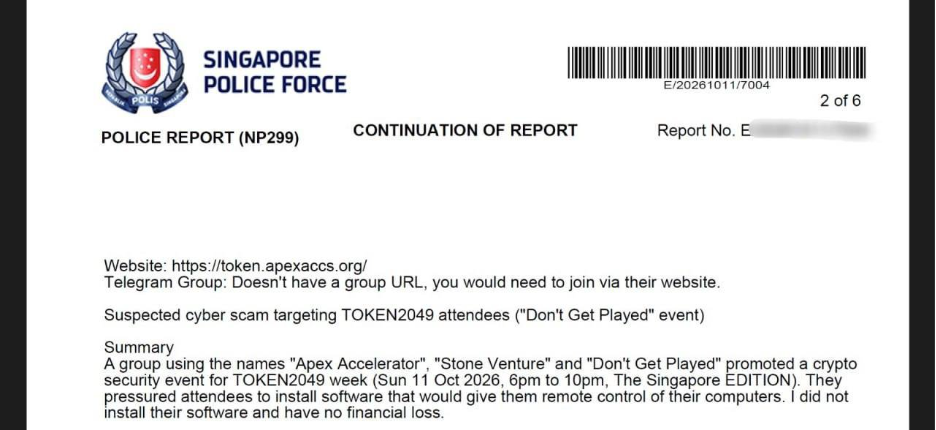
The report is titled “Suspected cyber scam targeting TOKEN2049 attendees (‘Don’t Get Played’ event).” Its summary reads:
“A group using the names ‘Apex Accelerator’, ‘Stone Venture’ and ‘Don’t Get Played’ promoted a crypto security event for TOKEN2049 week (Sun 11 Oct 2026, 6pm to 10pm, The Singapore EDITION). They pressured attendees to install software that would give them remote control of their computers. I did not install their software and have no financial loss.”
Two details in that statement matter. First, the person who filed the report says they did not install anything. Second, they report no financial loss. The filing therefore documents an alleged attempt rather than a confirmed compromise.
How the TOKEN2049 Side Event Was Pitched
On paper, “Don’t Get Played” looked like exactly the kind of session a careful attendee would seek out. It was marketed as a security-focused gathering designed to help people protect themselves from token scams.
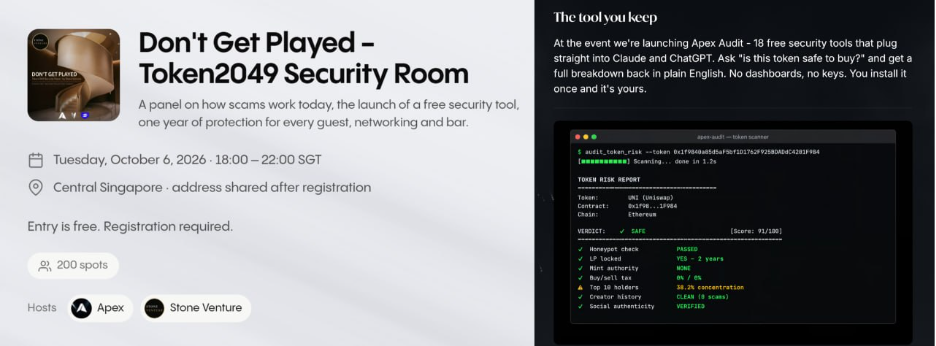
The event was scheduled for The Singapore EDITION hotel in early October 2026. Entry was free, though guests had to register beforehand, and attendance was capped at 200 people, as detailed by Crypto Briefing.
The agenda featured a live “wallet clinic” where attendees could have their holdings checked with “Apex Audit” tools. These were promoted as scanners for token risk and honeypots, a term for tokens engineered so that holders can buy them but are never able to sell.
The promotional material also advertised a panel on how crypto scams have evolved, listing representatives from Spartan Group, Bybit’s security team, and the Singapore Police Force Cyber Command among the speakers.
The final hook was a giveaway. Every confirmed guest was promised a free year of Sophos MDR endpoint protection, bundled with up to $1 million in breach coverage. Research into the event suggests this offer was a major driver of interest.
There is nothing in the available material indicating that Spartan Group, Bybit, Sophos, or the Singapore Police Force Cyber Command played any part in the alleged conduct. Their names appeared in the event promotion, and that is the full extent of what the sources establish.
The Allegation and the Gaps in the Record
The central claim is simple: organizers of “Don’t Get Played” allegedly pushed attendees to install software that would give a third-party remote access to their machines. At a crypto event, where many guests carry laptops connected to wallets and exchange accounts, that level of access could be enough to empty funds.
Several important facts remain unclear. The source material does not name the software attendees were allegedly asked to install. It does not state whether anyone lost money, and it does not say how many people may have been targeted.
As of October 12, 2026, no mainstream coverage of a police report involving the organizers, or of complaints from victims, could be located. The Singapore Police Force has not publicly confirmed the filing. Apex Accelerator and Stone Venture have not been charged with any offense based on the information available, and their account of events has not yet entered the public record.
How the Crypto Community Reacted to “Don’t Get Played”?
After SolanaFloor shared the police report on X, the replies split between people claiming firsthand contact, skeptics, and users offering security advice. The account 0xKYM Registry (@KYMRegistrySG) said it filed the report and shared what it described as a scan of the installation’s contents.
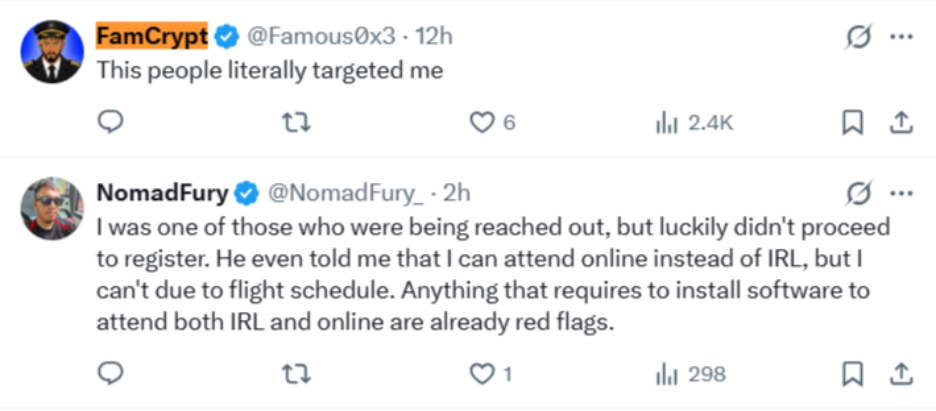
Several others, including FamCrypt (@Famous0x3), NomadFury (@NomadFury_), and Sabya | YeNo (@SabyaYeNo), said the group had approached or pressured them to install software or buy a subscription. Alex (@alwye) claimed Apex Accelerator had used similar tactics in Twitter DMs.
Not everyone was convinced. Sprunky (@sprunky_eth) argued that “page 2 of a report is not a finding,” noting the complainant lost nothing, SPF had not confirmed the filing, and no charges exist. Others questioned how anyone could be pressured in Singapore or who vetted the project for the TOKEN2049 lineup.
Security-minded users focused on the risk. StakeCraft (@stakecraft) called remote laptop access at a crypto event “a wallet drain waiting to happen,” and Jey (@TheWarKettle) advised anyone who installed the software to treat the device as compromised, move funds from a clean device, and rotate every password and key.
Others pointed to fake Luma after-party links and similar incidents at other conferences, and one user floated an unsupported DPRK link. Many replies also mocked the irony of a security event called “Don’t Get Played” allegedly becoming the play.
Conclusion
The “Don’t Get Played” allegations rest on a single attendee’s police report and a growing set of claims on X, none of which have been confirmed by authorities. Several questions remain open.
Will Singapore authorities confirm that a report was filed? Will Apex Accelerator or Stone Venture respond publicly? And will Spartan Group or the Singapore Police Force Cyber Command clarify whether they had any connection to the event? Until those answers arrive, the safest assumption for attendees is the one the event’s own name suggested: any request to install software deserves suspicion.
References:
Disclaimer: This blog is based on publicly available information, including a police report and posts shared on X, as of October 13, 2026. Cyble has not independently verified these claims. The allegations remain unproven, and naming any organization does not imply its involvement. This content is for informational purposes only and is not legal or financial advice.
The post “Don’t Get Played”: TOKEN2049 Security Event Faces Remote-Access Scam Allegations appeared first on Cyble.