
Know How Cyble Brand Intelligence Can Help Stop ClickFix Campaigns in its Tracks
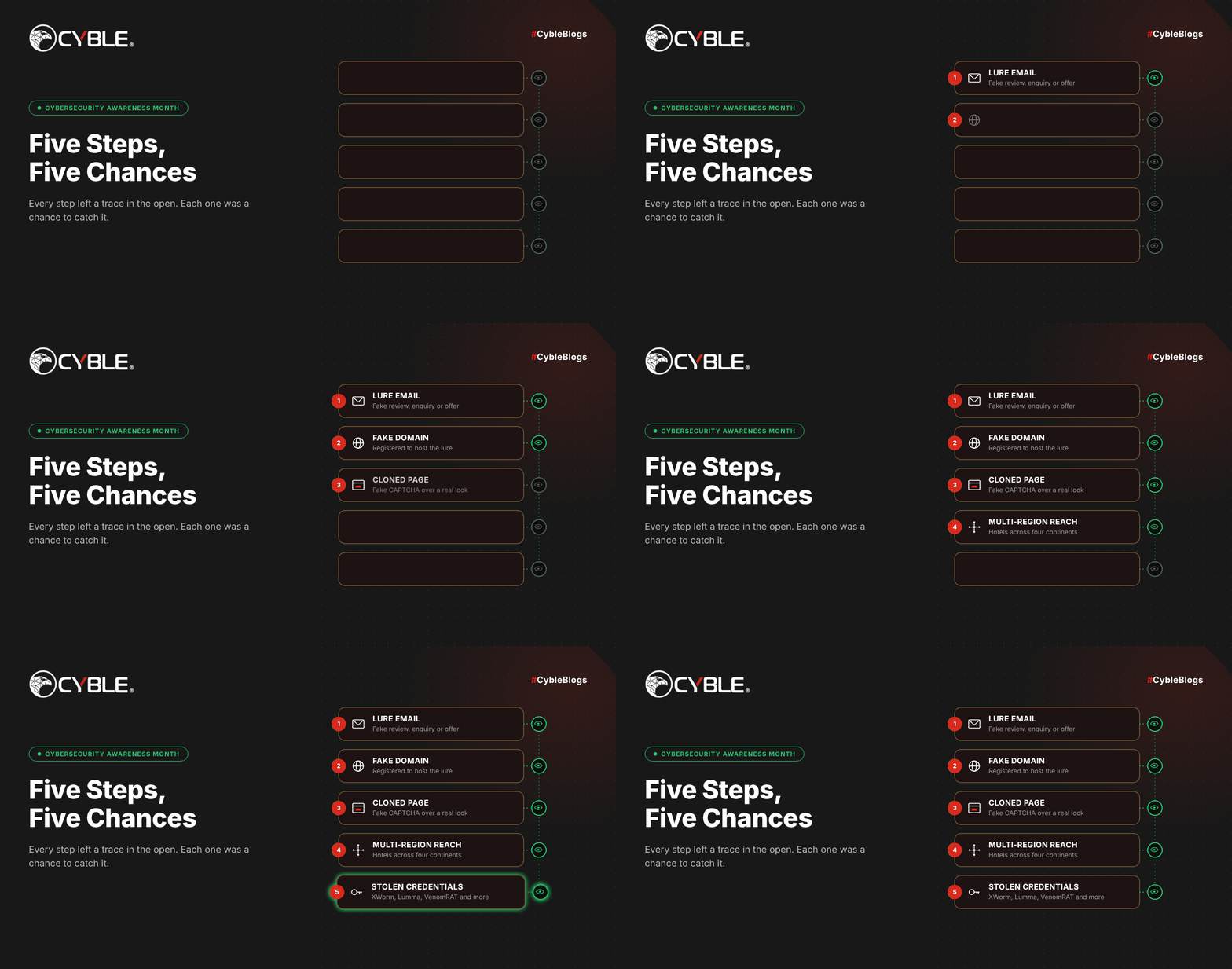
Booking.com’s systems were never breached. Its name was. Storm-1865 spent months borrowing Booking.com’s identity to get into hotel computers, and every step of that borrowing left traces on the open internet.
The open internet is exactly where Cyble Brand Intelligence & Protection works. Walk through the campaign one step at a time, and at each step there is a point where it could have spotted the attacker, cut the attack short or limited the damage.
What happened
From December 2024, a group Microsoft tracks as Storm-1865 posed as Booking.com to target hotel and hospitality staff across North America, Europe, Oceania and South and Southeast Asia. Microsoft Threat Intelligence published its findings on March 13, 2025, and said the campaign was still running as of February 2025.
The attack had four moving parts:
- The lure. Emails styled as Booking.com messages about negative guest reviews, guest enquiries, promotion offers or account verification.
- The landing page. A link, sometimes inside a PDF, opened a fake CAPTCHA laid over a faint copy of a real Booking.com page.
- The trick. The “verification” told staff to open the Windows Run box and paste a command the page had already copied to their clipboard.
- The payload. That command used mshta.exe to pull commodity malware, including XWorm, Lumma Stealer, VenomRAT, AsyncRAT, Danabot and NetSupport RAT, all built to steal credentials and payment data.
This was not a one-off. Microsoft says Storm-1865 targeted Booking.com guests in 2023 and e-commerce buyers in 2024 before adding ClickFix. Booking.com told Infosecurity Magazine its own systems were not breached, but some accommodation partners and customers were hit.
Why the impersonated brand holds the first move
Booking.com could not install security software on the laptops of its accommodation partners. What it could reach was the attacker’s infrastructure copying its brand, and that infrastructure was detectable. Microsoft’s own email security flagged URLs in this campaign as impersonating booking.com.
The stakes are high. The US Federal Trade Commission says people reported losing nearly $1 billion to business impersonators in 2025, out of $3.5 billion lost to imposter scams overall. Every copy of a brand caught early is one fewer victim.
Five steps, five chances to step in
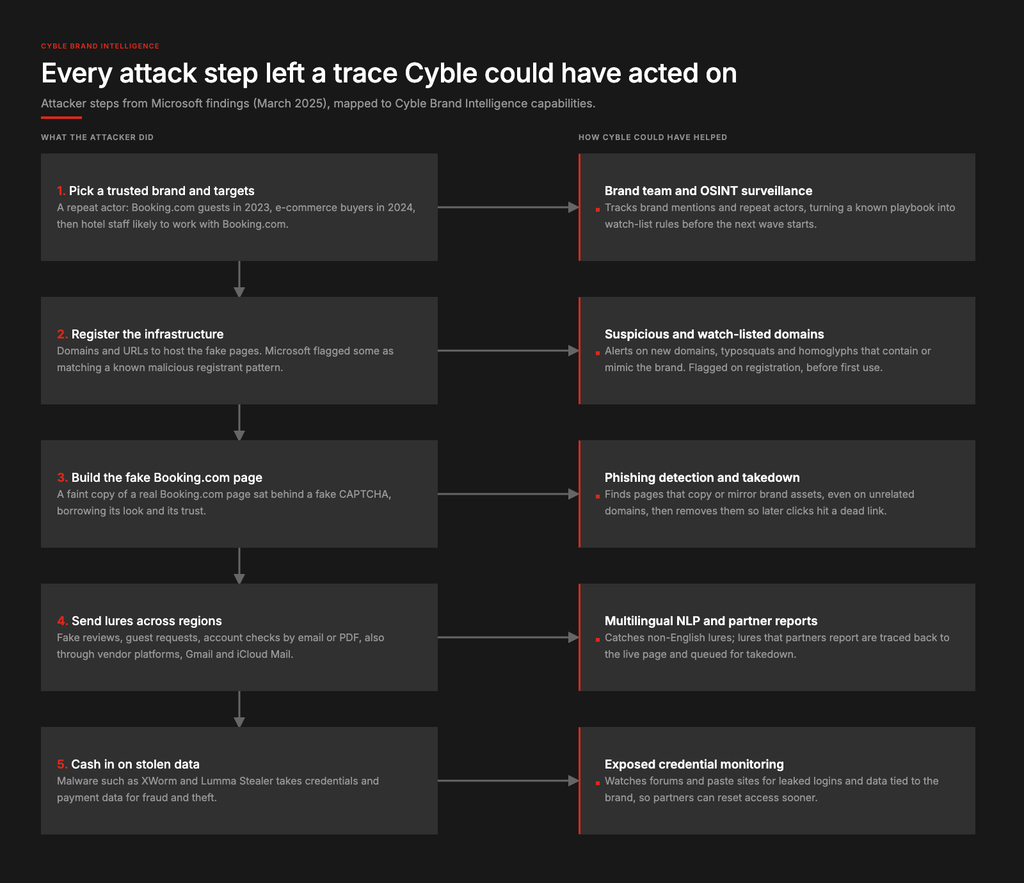
Storm-1865 needed Booking.com’s credibility at every stage of the attack. Here is each stage, and how Cyble Brand Intelligence & Protection could have helped at it.
Step 1: Pick a trusted brand and a target list
What the attacker did. Storm-1865 was a repeat player. Microsoft says it went after Booking.com guests in 2023 and e-commerce buyers in 2024, then turned to hotel staff most likely to work with Booking.com.
How Cyble could have helped. Cyble’s in-house brand team and OSINT surveillance track brand mentions and the actors who keep returning to a brand. A known playbook becomes a set of watch-list rules, so the next wave is expected rather than discovered after the fact.
Step 2: Register the infrastructure
What the attacker did. The campaign needed domains and URLs to host its fake pages. Microsoft flagged some of them as matching a known malicious registrant pattern.
How Cyble could have helped. Suspicious & Watch-Listed Domain monitoring tracks new registrations and DNS activity for typosquats, homoglyphs and lookalike domains, including AI-generated ones. A domain built to impersonate the brand can be flagged when it is registered, before it hosts a single page.
Step 3: Build the fake Booking.com page
What the attacker did. Victims landed on a fake CAPTCHA laid over a faint copy of a real Booking.com page. The familiar look was the point: it made a strange request feel routine.
How Cyble could have helped. Phishing Detection finds sites impersonating the brand, and Watermarking Surveillance spots copied or mirrored brand assets, even on domains with no brand name in them. Automated Takedown then works to get confirmed pages removed. Every hotel that clicks after a takedown hits a dead link instead of a trap.
Step 4: Send lures across regions
What the attacker did. Emails and PDFs about negative reviews, guest requests, promotions and account checks went to hotels across North America, Europe, Oceania and Asia. Some came through vendor platforms and ordinary services such as Gmail and iCloud Mail.
How Cyble could have helped. Multi-language NLP is built to catch phishing and impersonation attempts that are not in English, which matters for a campaign spread across this many markets. Lures that partners report can be handed to Cyble’s brand team, traced to the live page behind them and queued for takedown.
Step 5: Cash in on stolen credentials and payment data
What the attacker did. Once a staff member pasted the command, malware such as XWorm, Lumma Stealer and VenomRAT went to work. Microsoft says every payload in the campaign could steal credentials and financial data for fraud.
How Cyble could have helped. Stopping the pasted command itself is a job for endpoint and email controls. What Cyble adds is the aftermath: OSINT surveillance watches forums, blogs and paste sites for exposed credentials and data leaks tied to the brand. Spotting stolen partner logins early gives everyone time to reset access before fraud follows.
This walkthrough maps public research to Cyble’s capabilities. It is not a claim that Cyble took part in the response to this campaign.
Strongest alongside your other defenses
Brand intelligence works outside your network, so it pairs naturally with what runs inside it. When a lure arrives from an ordinary Gmail or iCloud address, there is no fake sender domain to flag, so the landing page becomes the asset to hunt. And if someone does run the pasted command, email filtering, endpoint detection, script controls and phishing-resistant MFA, the mitigations Microsoft recommends, do the stopping. Brand intelligence makes sure far fewer people ever reach that moment.
Is your brand the next Target? Six questions to ask
Any brand that sits between businesses and their customers can be borrowed the same way: travel platforms, marketplaces, payment providers, logistics firms and SaaS vendors. Ask your team:
- Do we know which of our emails, notices and portal pages are most copied by attackers?
- Are we alerted when a domain containing our name, or a homoglyph of it, is registered?
- Can we spot a cloned page even when it sits on an unrelated domain or free hosting?
- How long does it take us to get a confirmed phishing page taken down?
- Do our partners know how to report a suspicious message that uses our name?
- Do we watch criminal forums and channels for kits or templates built around our brand?
If more than two answers are “no” or “not sure,” the attacker’s preparation phase is happening without anyone watching.
The takeaway
Look back at the five steps and a pattern stands out. Storm-1865 needed Booking.com’s credibility at every one of them, and every one left a trace outside the victims’ networks.
With Cyble Brand Intelligence & Protection watching, each trace becomes a chance to step in: a repeat actor on the watch list, a lookalike domain flagged at registration, a cloned page taken down, a lure traced to its source, a leaked login caught early. If your partners and customers trust your name, Cyble helps make sure nobody else gets to use it.
See how it works for your brand: request a personalized demo.
References
- Microsoft Threat Intelligence, Phishing campaign impersonates Booking.com, delivers a suite of credential-stealing malware, March 13, 2025
- Infosecurity Magazine, ‘ClickFix’ Phishing Scam Impersonates Booking.com to Target Hospitality (includes Booking.com statement)
- US Federal Trade Commission, 2025 imposter scam data release, June 2026
- Cyble, Brand Intelligence & Protection datasheet v1.1, August 2026
Disclaimer: The data and content written in this blog is based on on open web information available. Analysts and researchers are advised to confirm once again from original sources.
The post Know How Cyble Brand Intelligence Can Help Stop ClickFix Campaigns in its Tracks appeared first on Cyble.