
Europe’s 2027 Cyber Compliance Year: What’s Fixed, What’s Moving, and What One Incident Looks Like Under Four Laws
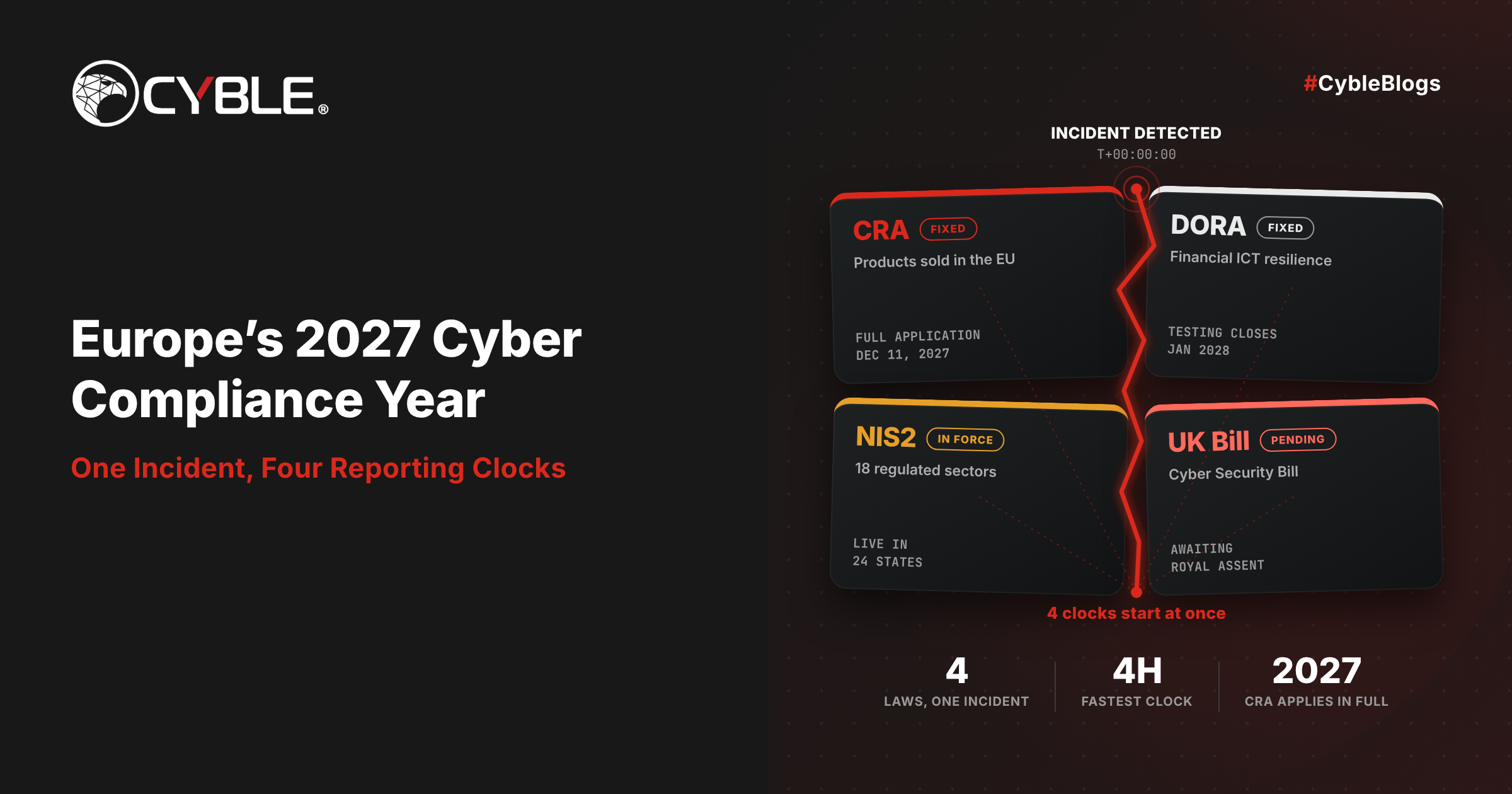
On Dec. 11, 2027, the EU’s Cyber Resilience Act applies in full, and every new connected product placed on the European market will need security built in and a CE mark to prove it. That is the date most 2027 planning decks lead with. It is also the only big date of the year that is truly fixed.
Around it, almost everything else is in motion. NIS2 is being amended while three member states still haven’t passed it. DORA’s first round of threat-led penetration testing (simulated attacks on live systems) is underway, and the list of tech providers it supervises directly is due for review. The UK’s Cyber Security and Resilience Bill is weeks or months from becoming law, with its duties phased in after that.
So the useful question for 2027 isn’t “what’s due when?” It’s “which of these dates can I build on, which might move, and which depend on things that aren’t ready yet?” This 2027 cyber compliance guide sorts all four regimes that way. It then follows a single cyber incident through all four laws at once, because that is where the overlap actually hurts.
The four laws in brief
The Cyber Resilience Act (CRA) regulates products: hardware and software with digital elements sold in the EU. Manufacturers must design them securely, handle vulnerabilities for a set support period and report actively exploited flaws.
NIS2 regulates organizations: “essential” and “important” entities in 18 sectors, from energy and health to managed IT services. It requires risk-management measures, incident reporting and accountability for senior management. As a directive, it works through national laws.
DORA, the Digital Operational Resilience Act, regulates the financial sector’s ICT resilience. It has applied since January 2025, and for banks, insurers and other financial entities it takes precedence over NIS2. It also lets EU financial supervisors oversee critical tech providers directly.
The UK Cyber Security and Resilience Bill updates the UK’s 2018 NIS Regulations. It brings managed service providers, data centres and designated critical suppliers into scope for the first time and tightens incident reporting. It doesn’t apply in the EU, and the EU laws don’t apply in the UK, but a UK company selling products or services into the EU can face all four.
What’s fixed: the dates you can build on
These are in force or set in law, and nothing on the legislative calendar is likely to move them.
CRA reporting is already live. Since Sept. 11, 2026, manufacturers must report actively exploited vulnerabilities and severe incidents affecting their products: an early warning within 24 hours and a fuller notification within 72, submitted through ENISA’s Single Reporting Platform. The European Commission is explicit that this covers products already on the market, not just new ones. If your 2027 plan still lists CRA reporting as a future task, it’s a year late.
The CRA applies in full on Dec. 11, 2027. From that date, the essential security requirements, technical documentation, software bill of materials (SBOM) and CE marking apply to products placed on the EU market. Products already on sale before then are caught by these requirements only if they are substantially modified afterwards. Open-source software stewards also pick up reporting duties on the same day.
DORA’s first testing cycle closes in January 2028. Financial entities designated as significant must run threat-led penetration testing at least every three years. DORA has applied since Jan. 17, 2025, so the first cycle runs out in January 2028, and 2027 is when most of those tests will happen. Each one involves live production systems and often the entity’s critical tech suppliers.
NIS2 is live in 24 member states. Where a national law is in force, the obligations already apply: registration, risk-management measures, 24-hour early warnings for significant incidents and management accountability. 2027 isn’t a NIS2 start date for most of the EU. It’s the second year of supervision.
Talk to Cyble about 2027 Cyber Compliance readiness and see how exploitation intelligence fits into your CRA and NIS2 reporting process.
What’s moving: rules being rewritten while you comply
NIS2 is being amended before it’s finished. France, Ireland and Spain still had no national NIS2 law in force in November 2026, and the Commission referred late countries to the EU Court of Justice in July. France’s National Assembly passed its bill at first reading on Nov. 17, 2026; it still needs a joint committee of both chambers.
Meanwhile, the Commission’s January 2026 amending proposal would add a small mid-cap category that moves many companies from “essential” to “important,” standardize ransomware reporting data and let a cyber posture certificate count as proof of compliance. The Commission is aiming for political agreement in early 2027, and member states would then have a year to transpose the changes. Plan against today’s national law; budget for a second update in 2028.
The Cybersecurity Act is being replaced. The same package proposes a new Cybersecurity Act (often called CSA2) that would let the EU name third countries that pose a cyber risk and restrict high-risk suppliers of key ICT assets used by NIS2 entities. If adopted in the form proposed, that becomes a supply-chain question for every NIS2 organization.
Incident reporting may get a single front door. The Digital Omnibus simplification package proposes one entry point for reporting incidents under several EU laws. The Council’s Oct. 21, 2026 position favors a national single entry point in each country plus an EU information point run by ENISA. It’s still a proposal, so the separate channels remain the ones that count in 2027.
DORA’s supervised-provider list is due for review. EU financial supervisors designated 19 critical ICT third-party providers, including AWS, Microsoft and Google Cloud, in November 2025, and are expected to reassess the list during 2027 using 2026 data. A provider that lands on it gets direct EU oversight; its financial-sector customers get new contract and exit-planning questions.
The UK Bill is close but not yet law. The House of Lords finished with the Bill on Nov. 2, 2026, and it went back to the Commons over two amendments peers had made. Royal Assent is expected between late 2026 and spring 2027. Most duties then arrive through secondary legislation, and a House of Lords Library briefing says commencement may run through 2028. Medium and large managed service providers will have three months from commencement to register with the Information Commission (the renamed ICO).
What depends on infrastructure that may be late
The CRA’s Dec. 11, 2027 date is fixed. What isn’t fixed is whether the machinery for meeting it will be ready.
Harmonised standards. Most manufacturers would prefer to show compliance by applying harmonised European standards, which give a legal presumption of conformity. As of late August 2026, no CRA harmonised standard had been cited in the EU’s Official Journal for any product category, and the cross-product standard covering all the essential requirements isn’t due until 2027.
Notified bodies. Products in the CRA’s “important class II” and “critical” categories need a third-party assessment from a notified body. So do “important class I” products, such as password managers, VPNs, browsers and smart home devices, unless the manufacturer fully applies a harmonised standard or certification scheme. The rules for designating these bodies have applied since June 11, 2026, but none had been designated by late June, and the target of having enough of them by Dec. 11, 2026 is a best-efforts goal.
Put those together and the practical deadline for many manufacturers is earlier than December 2027. If a class I product can’t rely on a published standard, it may need a notified body, and assessment slots are likely to fill up well ahead of the deadline. The safe assumption is that standards arrive late and assessors are scarce: start the technical file and risk assessment now, and book an assessor as soon as one is designated for your product category.
One incident, four clocks
Comparison tables make these laws look like separate tracks. They stop being separate the moment something goes wrong. Here is a single, hypothetical incident and every reporting clock it starts.
The setup. A UK-headquartered managed service provider runs IT for European customers, including a bank in the EU. It also sells its own remote-management agent, the software installed on every customer machine it looks after. At hour zero, it discovers that attackers used an unknown flaw in that agent to push ransomware across several client networks, including the bank’s.
Clock 1: DORA, for the bank. The bank must decide whether this is a “major” ICT incident. If it is, the initial notification to its financial supervisor is due within four hours of that decision and no later than 24 hours after the bank became aware. An intermediate report follows within 72 hours of the initial one, and a final report within a month after the last intermediate report. The bank can’t write any of them without facts from the provider, which is why DORA requires ICT contracts to include help during incidents.
Clock 2: NIS2, for the provider. Managed service providers are in scope of NIS2. A provider based outside the EU that serves EU customers must name a representative in a member state and answers to that country’s authority. For a significant incident, NIS2 requires an early warning within 24 hours, an incident notification within 72 hours and a final report within a month.
Clock 3: the CRA, for the provider as a manufacturer. The flaw is in a product the provider sells, and it’s being actively exploited. Under the CRA, that means an early warning within 24 hours, a vulnerability notification within 72 hours and a final report within 14 days of a fix being available, all through ENISA’s Single Reporting Platform. The provider must also tell affected users.
Clock 4: the UK Bill, once commenced. As a medium or large managed service provider, the company would also owe the UK regulator an initial notification within 24 hours and a full report within 72. If personal data was exposed, GDPR’s 72-hour breach notification makes it five clocks.
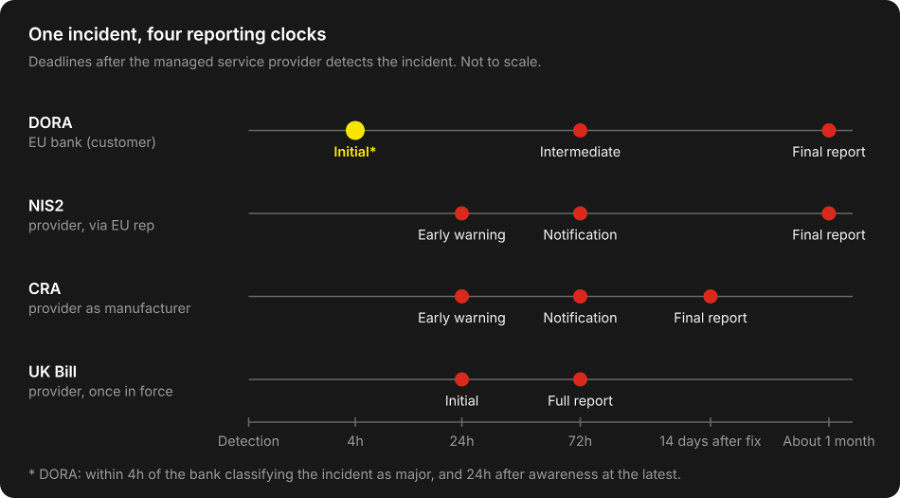
Three lessons fall out of the timeline. First, the earliest deadline belongs to the customer, not the company that was breached: the bank’s four-hour clock depends on information from the provider, so provider contracts need a customer notification commitment measured in hours, not days. Second, each law uses a different trigger, whether “major,” “significant” or “actively exploited,” so the same event can be reportable under one law and not yet under another. Third, the facts are the same in every report. Keep one incident record and map it to each format, rather than writing four reports from scratch at 3 a.m.
Reality check: what enforcement actually looks like
Search for NIS2 or DORA fines and you’ll find confident lists of six-figure penalties. Most can’t be traced to a regulator. Here is what can, alongside claims that keep circulating.
| Claim | Status | What the record shows |
| Austria’s FMA fined Western Union International Bank €42,000 under DORA (July 14, 2026) | Verified | Repeatedly late incident reports under DORA’s reporting rules |
| Romania’s DNSC fined a public body 50,000 lei, about €10,000, under NIS2 (Sept. 29, 2026) | Verified | Missing the deadline to notify the authority that it was in scope |
| Germany’s BSI fined a cloud provider €850,000 under NIS2 (February 2026) | Not traceable | Widely repeated; independent trackers found no published NIS2 fine as of July 2026 |
| “Most CRA obligations apply from September 2027” | Wrong | Reporting applied from Sept. 11, 2026; everything else from Dec. 11, 2027 |
| “DORA’s compliance deadline is in 2026” | Wrong | DORA has applied since Jan. 17, 2025 |
Two lessons. The first verified fines are about process, not breaches: a late report and a late registration. Supervisors are starting with the obligations that are easiest to prove, so registration deadlines and reporting clocks are where 2027 risk is most concrete. And the ceilings, up to €10 million or 2% of global turnover for essential entities under NIS2, are a long way from any penalty actually imposed so far. Use the ceilings to size the risk, not to predict the bill.
A 2027 plan in six moves
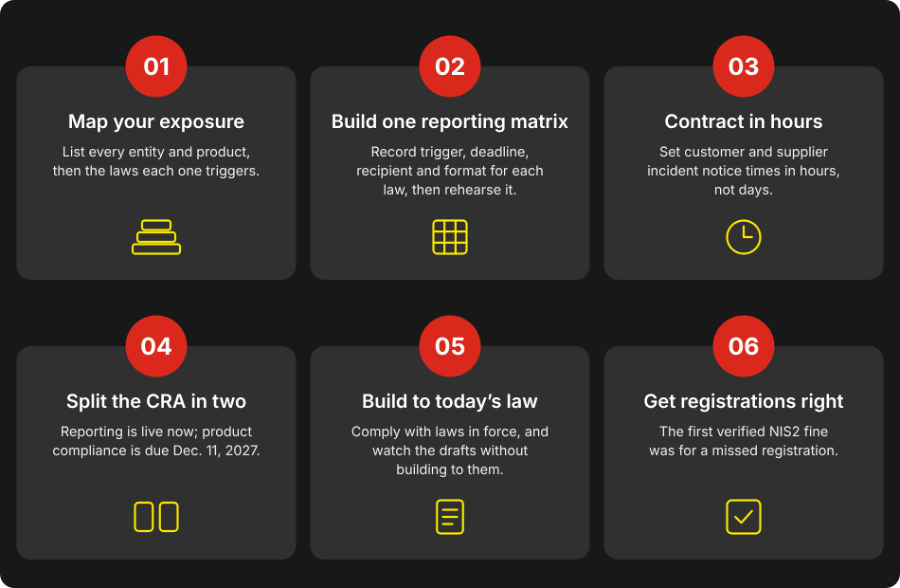
- Map exposure by entity and by product. NIS2, DORA and the UK Bill attach to what your organization is. The CRA attaches to what it sells. A UK software company with EU banking customers can be inside all four. List every legal entity and every product, then the regimes each one triggers.
- Build one reporting matrix and rehearse it. For each regime, record the trigger, the deadline, the recipient and the format. Then run the four-clock scenario above as a tabletop exercise and time how long it takes to decide whether an incident is “major,” “significant” or “actively exploited.”
- Rewrite supplier contracts around hours. Your customers’ clocks may start before yours. Agree customer notification times in hours, make sure financial-sector contracts carry DORA’s required incident-assistance terms, and require component suppliers to tell you about exploited vulnerabilities fast enough for your own CRA reporting.
- Run the CRA as two projects. Reporting is live and operational. Product compliance is a December 2027 engineering project: risk assessments, technical files, SBOMs, support periods and, for some products, a notified body. Don’t let the second wait on the first.
- Build to today’s law and watch the drafts. Comply with the national NIS2 law in force now, and track the amendments, CSA2’s supplier restrictions, DORA’s provider review and the UK’s commencement regulations without engineering to drafts that may change.
- Get registrations right. The first verified NIS2 fine was for a missed registration notice. Check NIS2 registration in every country where you operate, and if you’re a UK managed service provider, have your registration ready for the three-month window after commencement.
The question that starts the CRA clock
One phrase in the CRA deserves more attention than it gets: “actively exploited.” A vulnerability in your product isn’t reportable just because it exists. The 24-hour clock starts when you know it’s being used in attacks. That knowledge rarely comes from inside your own engineering team. It comes from exploitation seen in the wild, chatter on criminal forums, proof-of-concept code and attacks on other organizations running the same component.
That makes threat intelligence a compliance input, not just a security one. Cyble tracks vulnerability exploitation, dark web activity and attacker infrastructure across the open, deep and dark web, which is the evidence a manufacturer needs to know when its clock has started and to show regulators why it reported when it did.
Frequently asked questions
What cyber compliance deadlines fall in 2027?
The main fixed date is Dec. 11, 2027, when the EU Cyber Resilience Act applies in full, including essential security requirements, SBOMs and CE marking for products placed on the EU market. DORA’s first three-year cycle of threat-led penetration testing also runs through 2027 and ends in January 2028. NIS2 amendments and the UK Cyber Security and Resilience Bill’s commencement are expected but not yet fixed.
Do UK companies have to comply with the CRA, NIS2 and DORA?
Yes, if they sell into the EU. The CRA applies to any product with digital elements placed on the EU market, wherever the manufacturer is based. NIS2 can apply to UK providers serving EU customers, which must appoint an EU representative. DORA applies to EU financial entities and reaches UK tech providers through contracts and, for critical providers, direct oversight.
When will the UK Cyber Security and Resilience Bill take effect?
Royal Assent is expected between late 2026 and spring 2027. Most duties will then be brought in by secondary legislation, possibly in phases through 2028. Medium and large managed service providers will have three months from commencement to register with the regulator.
Does DORA replace NIS2 for banks?
For financial entities, DORA is the sector-specific law and takes precedence over NIS2 on ICT risk management, incident reporting, testing and third-party risk. A bank reports major ICT incidents under DORA’s timelines, not NIS2’s.
Has anyone been fined under NIS2 or DORA?
Yes, but the verified fines are small. Austria’s financial regulator fined a bank €42,000 under DORA in July 2026 for late incident reports, and Romania’s cybersecurity directorate fined a public body about €10,000 under NIS2 in September 2026 for a late registration notice.
Sources
- European Commission, Safer and more secure digital products, Sept. 11, 2026
- European Commission, Cyber Resilience Act policy page
- European Commission, Proposal amending the NIS2 Directive, COM(2026) 13
- Mayer Brown, European Commission proposes major cybersecurity package, February 2026
- Austrian Financial Market Authority, DORA: ICT-related incidents (reporting time limits)
- NIS2 transposition tracker, nisd2.eu, as of Nov. 18, 2026
- Syncplify, The compliance deadlines that moved (verified first fines)
- Prodefence, Romania’s first NIS2 fine, Sept. 30, 2026
- Greenbone, CRA Article 14 readiness status (harmonised standards and notified bodies)
- Cyber Security and Resilience Bill tracker, Bill clears the Lords, Nov. 3, 2026
- Wavenet, Cyber Security and Resilience Bill: what UK organisations need to know
Disclaimer: The data and content written in this blog is based on on open web information available. Analysts and researchers are advised to confirm once again from original sources.
The post Europe’s 2027 Cyber Compliance Year: What’s Fixed, What’s Moving, and What One Incident Looks Like Under Four Laws appeared first on Cyble.